Why a Mini Trampoline Workout Can Feel Deceptively Easy While Still Delivering a Real Cardio Load
You finish twenty minutes on the rebounder and feel… fine. Pleasant, even. Nothing hurts, nothing pounded, you weren’t gasping.
So you file it as “not a real workout” and go looking for something harder.
Then somebody straps a heart rate monitor on you and you find out your average was 145.
Quick Answer: A rebounder’s flexible surface absorbs the jarring impact sensation that running on pavement produces, while your cardiovascular system works just as hard underneath. Because people instinctively judge intensity by how pounding a workout feels, a low-impact session gets mentally filed as low effort regardless of actual heart rate. The fix: judge rebounder intensity with a heart rate monitor instead of felt impact — the felt-impact cue simply doesn’t apply to a workout designed to remove impact.

Why Does a Rebounder Workout Feel Easier Than It Is?
Because two signals that normally travel together have been separated.
When you run on pavement, every footfall sends a sharp deceleration force up through your legs. You feel that. It’s loud, jarring, and unmistakable — and your brain files it as evidence of hard work.
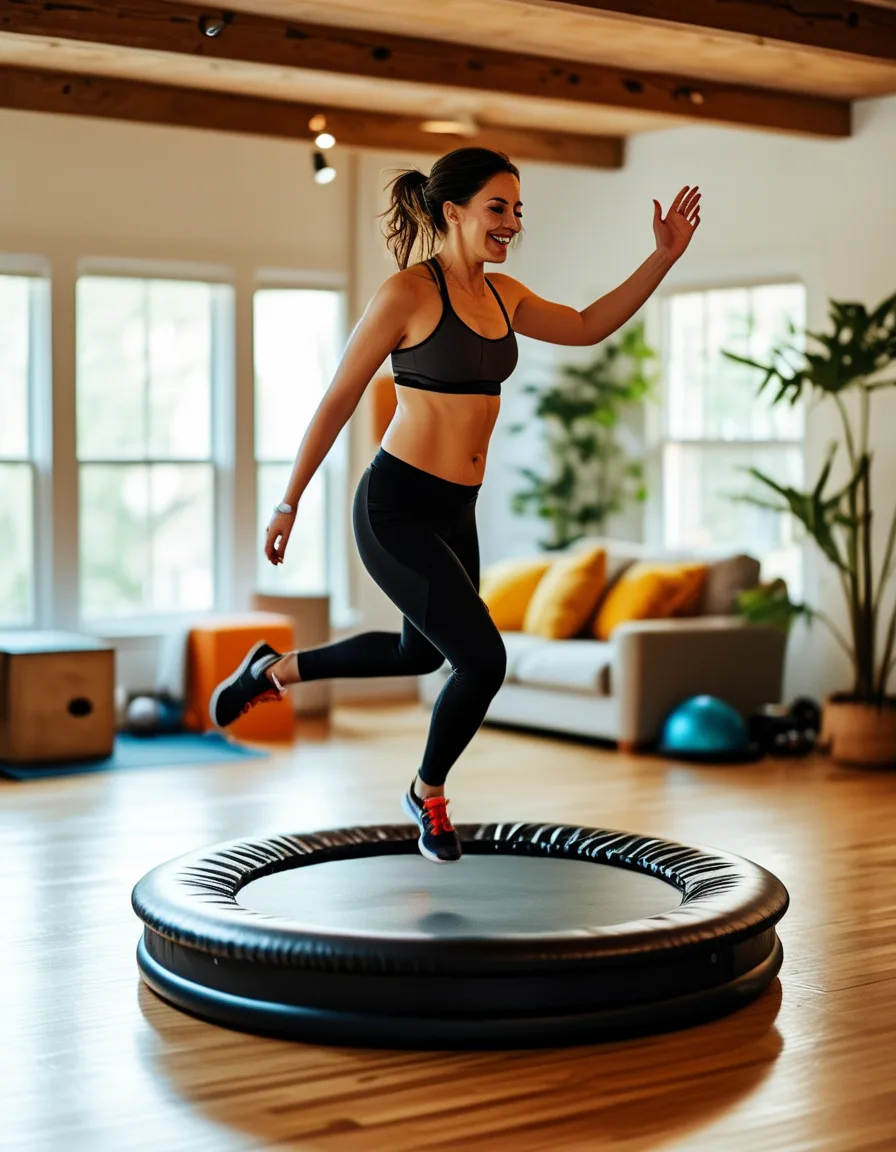
On a rebounder, the mat flexes and decelerates you gradually instead of abruptly. The force is spread across a longer time window, which is precisely what removes the jarring sensation. That’s the entire design goal of the equipment.
But your muscles are still driving you upward against gravity, repeatedly, and your heart and lungs are still supplying the oxygen for that. The cardiovascular demand is essentially unchanged; only the impact sensation is gone.
Normally impact and effort move together, so using one to estimate the other works fine. A rebounder decouples them, and your usual heuristic quietly gives you the wrong number.
There’s a secondary factor too: rebounding recruits a lot of stabilizer muscles for balance, and stabilizer work is metabolically real but doesn’t produce the strong local burning sensation you get from a big muscle under load. So another effort cue is muted as well.
Why Does the Mismatch Matter?
Because it produces two opposite mistakes, and both cost you.
Mistake one: dismissing the workout. You conclude it “doesn’t count,” stop doing it, and go back to something that hurts more — which is a shame, because the whole value proposition of a rebounder is a real cardio load with a fraction of the joint stress. That’s a genuinely useful trade for anyone with knee, hip, or back issues, anyone returning from injury, or anyone whose joints are simply tired of pavement. Discarding it because it felt pleasant is discarding the actual benefit.
Mistake two: never progressing. If you assume the session is easy, you never push it, and you keep doing the same comfortable 20 minutes for months. This is the more common failure. The workout is capable of considerably more than most people ask of it, and perceived exertion won’t tell you when to ask.
There’s also a third, quieter version: people who do push hard on a rebounder sometimes under-recover, because the session didn’t feel demanding enough to warrant a rest day. Your cardiovascular system doesn’t care whether the effort felt jarring.
How Do You Judge Rebounder Intensity Properly?
Replace the broken cue with a working one.
Use a heart rate monitor. This is the fix. A chest strap is more accurate than a wrist optical sensor, particularly during bouncing where wrist movement creates noise, but either beats guessing.
Rough zones, using the very approximate 220 − age estimate for maximum heart rate:
- Moderate: about 50–70% of max. Sustainable, conversational-ish.
- Vigorous: about 70–85% of max. Interval territory.
Watch what happens on your first monitored session. Most people are surprised, and the surprise is the point — you now have a number where you previously had a misleading sensation.
If you don’t have a monitor, use these instead:
- The talk test. Can you speak in full sentences? That’s moderate. Only a few words at a time? Vigorous. This is a genuinely reliable proxy and it costs nothing.
- Breathing rate. Noticeably elevated is the target for a working session.
- Performance markers. Time to fatigue, how many intervals you can hold form through, how quickly your heart rate recovers after a hard minute.
How to actually raise the intensity, once you know where you are:
- Bounce higher — more vertical displacement means more work per rep.
- Add arms — overhead reaches, punches. More muscle mass recruited.
- Interval it — 30 seconds hard, 30 seconds easy, repeated. The most effective single change.
- Add movements — jumping jacks, high knees, twists on the mat.
- Add light hand weights — carefully, and only once your balance is solid.
Myth vs Fact
Myth: Low-impact means low-intensity. Fact: They’re independent variables. Impact describes the force your joints absorb; intensity describes the metabolic demand. Swimming and cycling are both low-impact and can be extremely intense — a rebounder is the same category.
Myth: If it doesn’t feel hard, it isn’t working. Fact: Perceived exertion is influenced heavily by impact and local muscular burn, both of which are muted on a rebounder. Heart rate is the more reliable measure for cardiovascular work, and it frequently disagrees with the felt sense here.
Myth: A rebounder is only good for gentle movement or lymphatic circulation. Fact: Intensity is set by what you do on it, not by the equipment. Interval-based rebounder sessions can reach vigorous heart rate zones comfortably.
Myth: You can’t get hurt on a rebounder because it’s soft. Fact: Lower impact isn’t no risk. Ankle rolls from landing off-center, falls from losing balance, and overuse from doing too much too soon all happen. Land in the center of the mat, keep knees soft, and consider a model with a stability bar if your balance is uncertain.
Myth: More is always better since it’s gentle. Fact: Your cardiovascular system and connective tissue still need recovery, and the low impact makes it easy to over-schedule. Two or three quality sessions a week with rest between beats daily grinding.
A caveat worth stating plainly: if you have a heart condition, joint problems, balance issues, or you’re pregnant or recently postpartum, check with a doctor before starting — and if you have any pelvic floor concerns, repeated bouncing is worth discussing with a pelvic health physio specifically.
FAQ
Is a mini trampoline a good workout?
Yes — it can deliver moderate-to-vigorous cardiovascular work with substantially less joint impact than running, which makes it useful for people managing knee, hip, or back issues. The catch is that it doesn’t feel as demanding as it is, so people tend to under-push it. Intensity depends on what you do on it, not on the equipment itself.
How do you know if your rebounder workout is intense enough?
Use a heart rate monitor, or the talk test if you don’t have one — full sentences means moderate, a few words at a time means vigorous. Don’t rely on how jarring or hard the session feels, since the rebounder is specifically designed to remove the impact sensation that normally signals effort.
How long should a rebounder workout be?
Twenty to thirty minutes is a reasonable target for a cardio session, and interval formats can be effective in less. Start shorter — ten to fifteen minutes — while your stabilizer muscles and balance adapt, since the low impact makes it easy to do too much too soon and feel it a day later.
TL;DR:
- The mat’s flex removes the impact sensation while cardiovascular demand stays essentially unchanged.
- People judge intensity partly by how jarring a workout feels — a cue that’s been deliberately engineered out here.
- Stabilizer recruitment adds real work without the local burn, muting a second effort cue.
- Two failure modes: dismissing the workout as not real, or never progressing it.
- Use a heart rate monitor — chest strap beats wrist during bouncing. Moderate ≈ 50–70% max, vigorous ≈ 70–85%.
- No monitor? Talk test. Full sentences = moderate, few words = vigorous.
- Raise intensity with intervals (30s hard / 30s easy), higher bounces, arm movements.
- Low impact isn’t no risk — land centered, keep knees soft, and rest between sessions.
Keep Reading
This article is for general informational and styling purposes only. Fit, sizing, and product availability may vary.