Rebounding for Weight Loss: 7 Things That Actually Decide the Outcome
Quick Answer: Rebounding burns roughly 200 to 400 calories an hour depending on intensity and body weight — comparable to a brisk walk or a light jog, not to sprint intervals. Whether it produces weight loss depends far more on consistency, session length, and what you eat than on the trampoline itself. The low joint impact is its genuine advantage: it lets people train more often without accumulating the wear that running does.
The internet will tell you rebounding is twice as effective as running. It will cite a study from 1980 about astronauts that did not measure weight loss at all.
Here is what actually decides whether a mini trampoline changes anything.

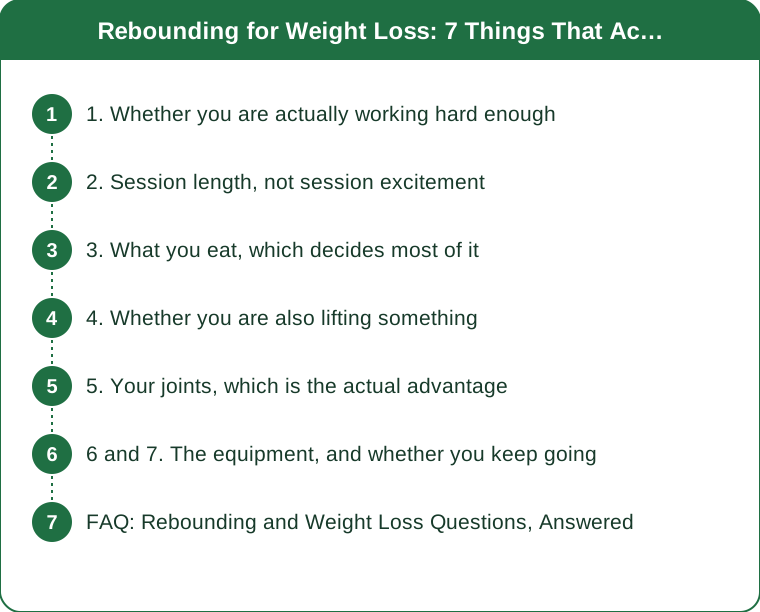
1. Whether you are actually working hard enough
This is the biggest variable and the easiest one to get wrong, because rebounding feels harder than it is at low intensity and easier than it is at high intensity.
A gentle health bounce — feet barely leaving the mat — is genuinely low intensity. It is excellent for circulation, joint mobility, and getting a sedentary body moving, and it burns roughly what a slow walk burns.
A real rebounding workout involves jogging on the mat, high knees, jumping jacks, and tuck jumps. That is where the 300-plus calorie hour lives.
The honest test: can you hold a full conversation comfortably? If yes, you are in the low-intensity band regardless of how pleasant it feels. Aim to be able to speak in short sentences but not paragraphs for the working portions.
Why this gets missed: the springy surface returns energy to you, which makes moderate effort feel more productive than it is. The trampoline is doing some of the work — that is the whole point of it, and it also means your perceived effort overstates your actual output.
2. Session length, not session excitement
Ten-minute sessions do not produce weight loss on their own. They are excellent for consistency and for getting started, and their calorie contribution is small.
The useful range is 20 to 40 minutes, 4 to 5 times a week. That is roughly 800 to 1,600 weekly calories at moderate intensity — enough to matter alongside diet.
Beyond 45 minutes, returns drop off for most people because the calf and foot fatigue starts degrading form before the cardiovascular benefit saturates.
Build volume gradually. Rebounding uses your calves, feet, and ankles heavily in a way most people are not conditioned for. Ten minutes in week one, adding 5 minutes a week, prevents the Achilles and calf soreness that ends most rebounding habits in month one.
3. What you eat, which decides most of it
No 30-minute workout out-earns a 600-calorie dietary difference, and this is the least popular true thing in fitness.
A 30-minute moderate rebounding session burns roughly 150 to 200 calories for many women. That is one large latte and a pastry, which is not a reason to skip the workout — it is a reason to stop expecting the workout alone to do it.
The realistic model: rebounding creates a moderate calorie deficit, improves cardiovascular fitness, and — critically — makes you more likely to keep moving. Diet decides the size of the deficit.
The compensation trap is real. Many people unconsciously eat more or move less on days they exercise. Tracking food for two weeks is the fastest way to find out whether this is happening to you.

4. Whether you are also lifting something
Rebounding is cardio. It builds some lower leg and core endurance and it does not build meaningful muscle.
Muscle mass is what protects your metabolic rate during weight loss. Losing weight through cardio alone means losing a share of it as muscle, which lowers the rate you burn at rest and makes maintenance harder later.
Two resistance sessions a week alongside rebounding changes the composition of what you lose substantially. Bodyweight work counts — squats, push-ups, rows, lunges — and it does not require a gym.
This is the most common structural gap in a rebounding-only plan and the one with the biggest downstream consequence.
5. Your joints, which is the actual advantage
This is where rebounding genuinely beats running, and it is the reason to choose it.
The mat absorbs a large share of landing force compared to pavement. For people with knee pain, higher body weight, previous injuries, or a long gap since regular exercise, that difference is the gap between exercising four times a week and exercising twice before something hurts.
Consistency beats intensity across a year. A person who rebounds five days a week for twelve months out-loses a person who ran hard for six weeks and then stopped because their knees objected.
Not zero impact, though. Your calves, Achilles, and feet still work hard, and rebounder-specific soreness is real. The load moves rather than disappearing.
6 and 7. The equipment, and whether you keep going
6. The rebounder itself
Spring tension changes both the workout and your joints. A very bouncy, loose rebounder gives more rebound and less muscular work. A firmer mat requires more effort per bounce and burns more.
Bungee-corded models are quieter and softer; steel spring models are firmer and cheaper. Either works; the difference in feel is significant enough to matter for whether you use it.
A stability bar is worth having if your balance is at all uncertain, particularly for anyone over 60 or returning after injury. Falling off a rebounder is the main safety risk and it is almost entirely preventable.
Cheap rebounders sag in the middle within months, which changes the bounce and increases ankle roll risk. The $100 to $200 range is where durability starts.
7. Whether you will still be doing it in March
Adherence is the variable that dwarfs all the others, and rebounding’s real edge is that it scores well on it.
It is at home, weather-proof, and low-barrier. No commute, no gym anxiety, and it works while something is on TV. In an autumn where daylight is shrinking and outdoor motivation is dropping, that matters more than any calorie number.
It is also easy to abandon because it is at home and nothing external holds you to it. Put it somewhere visible, not in a closet — the single strongest predictor of a home fitness device being used is whether it is set up and in the way.
Set a floor, not a target. Ten minutes on bad days is the rule that keeps a habit alive through a bad month, and the habit is the thing that produces the result.
FAQ: Rebounding and Weight Loss Questions, Answered
How many calories does 30 minutes of rebounding burn?
Roughly 100 to 200 calories at gentle intensity and 150 to 300 at vigorous intensity, depending heavily on body weight. Fitness tracker estimates for trampoline work tend to run high — treat them as a relative trend rather than an absolute number.
Is rebounding better than walking for weight loss?
At comparable intensity they are broadly similar. Rebounding scales up more easily to higher intensity in a small space, and walking is easier to do for very long durations. The better one is the one you will do more often.
Will it help with the lower belly specifically?
No exercise directs fat loss to a chosen area — spot reduction is not how fat loss works. Overall fat loss changes every area, in an order your genetics decide rather than your workout does.
Can I rebound every day?
Yes, if you vary intensity — hard sessions three or four times a week and gentle bouncing on the others. Daily hard sessions will find your Achilles and calves within a few weeks.
This is general information, not medical advice. Check with a professional before starting if you have joint, balance, or pelvic floor concerns.
TL;DR: Real exercise, honest numbers, and the advantage is joints rather than magic.
- 200 to 400 calories an hour depending on intensity — like brisk walking or light jogging, not double running.
- Gentle health bouncing is low intensity. Jogging, high knees, and tuck jumps are where the burn is.
- 20 to 40 minutes, 4 to 5 times a week is the range that contributes meaningfully.
- Diet decides most of the deficit. No 30-minute session out-earns a 600-calorie eating difference.
- Add two resistance sessions weekly or you will lose muscle along with the fat.
- The low joint impact is the genuine edge — it lets you train often, and often is what works.
Put the rebounder somewhere you have to walk past it, and set a ten-minute floor for bad days. That is the part that decides March.
Keep Reading
This article is for general informational and styling purposes only. Fit, sizing, and product availability may vary.