Bounce to the Beat: Structuring Rebounder Workouts by Song
Quick Answer: Structure a rebounder workout by song instead of by timer. Give each track one move — basic bounce, jacks, high-knee jog, twists, freestyle, cooldown — and let the playlist order handle your intervals. Six songs is roughly 22 minutes and a complete session. Match cadence to tempo: 100–115 BPM for warm-up, 120–135 for steady work, 140+ for sprints.
The rebounder and the playlist were made for each other, and almost nobody uses them that way.
Songs are natural intervals. Tempo is a built-in pace coach. And bouncing syncs to a beat with essentially zero cognitive effort, which means you can stop watching a timer and start just… moving until the song changes.
Structure the session by song and the workout paces itself. The timer app can retire.

Why Structure a Workout by Song?
Three reasons, and the third is the one that actually keeps people doing it.
Songs are the right length. Most tracks run 3 to 4 minutes, which is almost exactly the work-interval length you’d program deliberately. You get well-sized intervals without designing anything.
Playlist order becomes programming. Warm-up track, three or four work tracks, a recovery track, a finisher. The sequence you’d build in a training app already exists in every music app you own.
You stop counting. This is the real benefit. Watching a clock during hard intervals makes them feel longer, and it takes attention away from your form. When the song ends, the interval ends. Nothing to monitor.
Music as middleware — it sits between you and the workout and handles the admin.
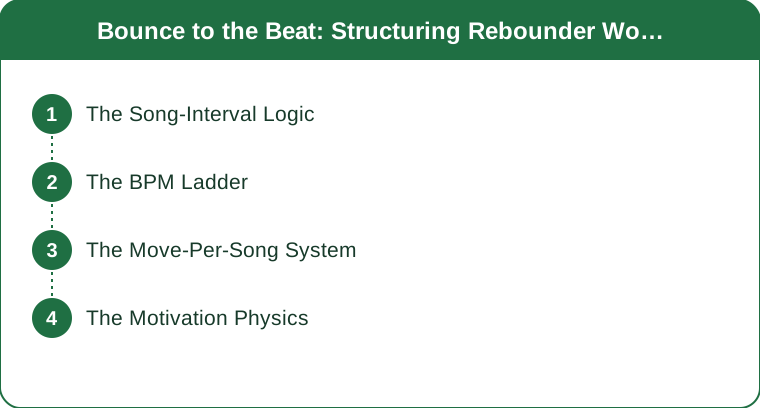
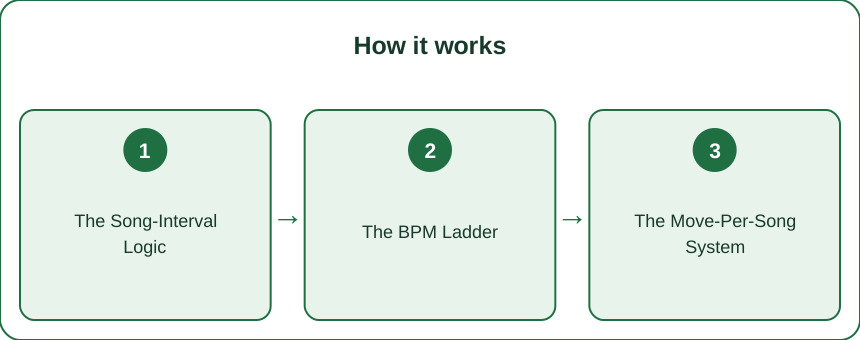
The BPM Ladder
Bounce cadence naturally follows tempo, so choosing tracks by BPM chooses your intensity for you.
100–115 BPM — the warm-up and cooldown zone. Health-bounce pace, heels staying low, everything gentle. Two tracks here, one at each end of the session.
120–135 BPM — the steady work zone. This is where jumping jacks, high-knee jogs, and twist bounces sit comfortably. Most of your session lives here.
140+ BPM — the sprint zone. Short, hard, and you’ll know it. One track, maybe two, and not at the start.
Most streaming platforms let you sort or search by tempo, and there are free BPM-lookup tools for individual tracks. Build the ladder once, save it, and ride it forever — you’re not doing this work again.
One practical note: songs with a strong, consistent four-on-the-floor beat work far better than songs with tempo changes or long ambient sections. A beautiful track that drops out for 40 seconds mid-song is a bad interval.

The Move-Per-Song System
Each track owns one move family. That’s the whole system, and its value is that you make zero decisions once the music starts.
Song 1 — basic bounce (100–115 BPM). Warm-up. Heels low, easy pace, letting the mat do the work.
Song 2 — jumping jacks (120–130 BPM). Feet and arms out and in on the beat. First real work track.
Song 3 — high-knee jog (125–135 BPM). Alternating knees, arms driving. The one that gets your heart rate up fastest.
Song 4 — twist bounces (120–130 BPM). Hips rotating one way, shoulders the other. Core work disguised as fun.
Song 5 — choose your chaos (140+ BPM). Freestyle, sprint bounces, whatever the track demands. This is the finisher.
Song 6 — health bounce cooldown (100 BPM or below). Heels down, breathing settling, done.
Six songs is roughly 22 minutes and a complete session with no mid-workout decisions. Want 30 minutes? Add two more work tracks between songs 3 and 5. Want 12? Run songs 1, 3, 5, and 6.
The Motivation Physics
Bouncing to music is self-reinforcing in a way treadmill music never quite manages.
The reason is timing. On a treadmill, the machine sets the pace and the music is decoration. On a rebounder, the mat returns your energy on your own rhythm — so when you sync to a beat, the equipment starts cooperating with the music rather than competing with it.
The workout tips into dance territory somewhere around minute six, and that’s the adherence jackpot. Exercise you’d describe as fun gets done substantially more often than exercise you’d describe as effective.
The practical version of this insight: the rebounder sessions that happen are the ones with a playlist ready. Build two or three and save them. The friction of picking music at the moment you’re supposed to start exercising is enough to kill a session.
5 Mistakes Everyone Makes
- Building the playlist during the workout. You’ll spend four minutes scrolling and never fully commit. Build it beforehand, once.
- Starting on a fast track. Cold ankles on an unstable surface at 140 BPM is how minor injuries happen. The warm-up song isn’t optional.
- Picking songs with tempo drops. Ambient breakdowns and half-time sections wreck the interval. Test the playlist once before relying on it.
- Bouncing off-beat and fighting it. If a track feels wrong, your natural cadence doesn’t match it. Move it to a different slot rather than forcing your pace.
- Skipping the cooldown song. Heart rate and ankles both appreciate the last three minutes. It’s the cheapest recovery you’ll ever get.
Mini FAQ
What BPM is best for a rebounder workout?
120–135 BPM for the bulk of a session. Warm up and cool down at 100–115, and use 140+ for short sprint intervals. Cadence follows tempo naturally on a rebounder, so choosing the tempo effectively chooses your intensity.
How long should a rebounder workout be?
Six songs — about 22 minutes — makes a complete session including warm-up and cooldown. That’s enough for a real cardiovascular effort. Extend to 30 minutes by adding work tracks; anything past 40 minutes has diminishing returns for most people.
Is rebounding good cardio?
Yes. It elevates heart rate effectively while being noticeably lower-impact on knees and ankles than running on pavement, since the mat absorbs a large share of the landing force. It’s a solid option for people who want cardio without joint loading — though as with any impact activity, ease in over a few weeks.
TL;DR:
- Songs are 3–4 minutes — the natural work-interval length. Let the playlist be the timer.
- BPM ladder: 100–115 warm-up/cooldown, 120–135 work, 140+ sprints.
- One move per song: basic bounce, jacks, high-knee jog, twists, freestyle, cooldown.
- Six songs ≈ 22 minutes, zero decisions mid-workout.
- Build two or three playlists in advance. Picking music at start time kills sessions.
One move per song, BPM as the coach, six tracks as the session. The rebounder never needed a timer — it needed a DJ, and your playlist app was already holding the application.
Keep Reading
This article is for general informational and styling purposes only. Fit, sizing, and product availability may vary.