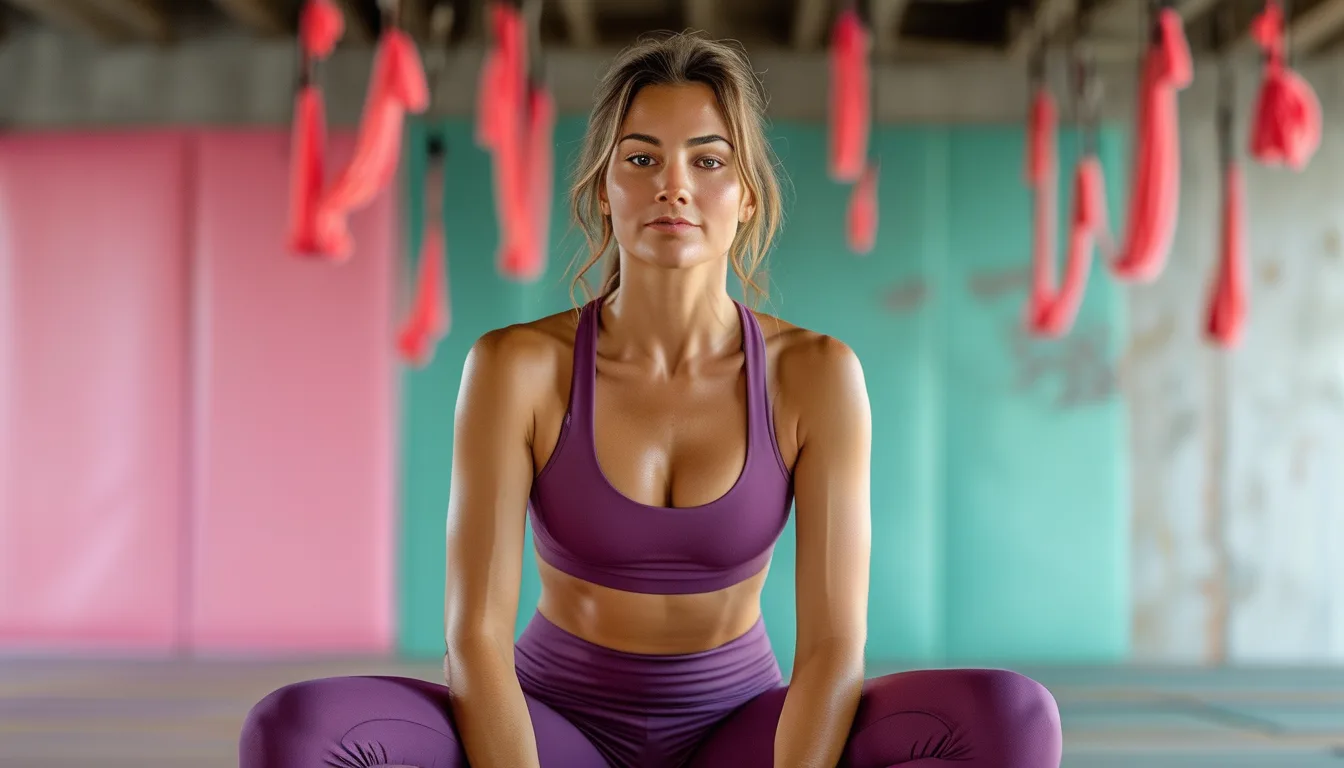
Rebounder Form: the Posture Rules That Make Bouncing a Workout Instead of a Wobble
Quick Answer: Rebounder results and safety both come down to form: soft knees always (never locked), tall spine with ribs over hips, gaze level at the horizon (not down at your feet — where the head goes, balance follows), core lightly braced, and bounces that push down into the mat rather than leaping for height. Master the low ‘health bounce’ — feet barely leaving the surface — before any jumping variety; it’s the foundation move, not the remedial one.
The mini trampoline’s marketing is all joy and burn — and fair enough — but watch a first-timer: eyes glued to their feet, knees locked, bouncing tall and drifting toward the rim like a slow shipwreck. The rebounder is genuinely low-impact and genuinely effective, with one catch: the mat amplifies whatever form you bring to it.

Why does form matter more on a rebounder than on floor?
Three amplifiers a stable floor doesn’t have:
- The moving surface: every landing is a micro-balance event — great training stimulus (it’s why rebounding builds stability so well), but it means posture errors compound per bounce instead of just existing. A forward-drifting gaze or locked knee that’s harmless standing becomes a per-rep wobble at 100+ bounces a minute.
- The rebound return: the mat gives energy back — with soft knees and a braced core, that return flows up through aligned joints; with locked knees, it arrives as jolt at the knee and lower back, converting the equipment’s low-impact promise into repetitive small insults.
- The drift problem: without a fixed visual anchor, bouncers migrate — toward the rim, where the springs’ geometry gets unpredictable and most rebounder mishaps actually happen. Center-of-mat is a discipline, not a default.
The good news hiding in all three: the form fixes are few, learnable in one session, and they are the workout upgrade — a controlled bounce works the core and stabilizers that a sloppy tall bounce skips entirely.
What are the form rules, top to bottom?
Gaze: level, at the horizon — pick a spot at eye height across the room and keep it. Looking down at your feet tips the head (5kg of forward lean), rounds the upper back, and sends balance chasing after — the single most common beginner error and the first fix.
Spine: tall, ribs stacked over hips — imagine a string from the crown of your head; no arching the lower back, no tucking. The bounce should travel through a stacked column.
Core: lightly on — a 20-30% brace (the ‘about to be poked’ firmness), maintained. This is what turns every bounce into quiet trunk work and what keeps the landing stable.
Knees: soft, always — slightly bent at landing and takeoff both; the legs are springs cooperating with the mat’s spring. Locked knees are the cardinal sin: jolting joints and killing the rhythm.
The bounce itself: push down, not up — the health bounce cue is pressing your feet into the mat and letting the rebound lift you barely off (or not off at all — heels can stay in light contact). Height is not the goal; rhythm and control are. Feet hip-width, weight through the whole foot, center of the mat.
The session structure for week one: 2-3 minutes of health bounce, 1 minute rest, repeated 3-5 times — boring on paper, and precisely how the balance system, ankles, and bladder-adjacent structures (worth being honest: many women notice pelvic-floor demands on rebounders — see FAQ) adapt before intensity arrives.

Myth vs Fact: Rebounder Edition
Myth: Higher bounces = better workout. Fact: The mat rewards push, not altitude — the low health bounce with active down-pressure recruits legs and core continuously, while high leaps add flight time (doing nothing) and landing chaos (doing harm). Advanced rebounder athletes bounce lower than beginners expect, faster and more controlled.
Myth: It’s a trampoline — no technique needed, just have fun. Fact: The fun is real and so is the amplifier effect: the same session that’s joint-friendly with soft knees and center-mat discipline is jolty and rim-drifty without. One session of form focus buys years of the good version.
Myth: Rebounding is automatically safe for everyone since it’s low-impact. Fact: Low-impact ≠ no-demand: balance challenges, pelvic-floor loading, and (for some conditions — joint issues, osteoporosis concerns, vertigo, pregnancy/postpartum) real considerations apply. The stability bar (many rebounders offer one) is a legitimate tool, not a shame handle — and specific conditions deserve a professional’s input before bouncing. This is general information, not medical advice.
The pattern: the rebounder is one of the friendliest cardio tools in existence at its foundation layer — the myths all involve skipping that layer.
FAQ: Rebounder Form Questions, Answered
I leak a little when bouncing — normal?
Common, and worth taking seriously rather than normalizing: bouncing loads the pelvic floor rhythmically, and leaking signals that system wants attention — lower bounce heights, the health-bounce-only menu, and pelvic floor training help many; persistent symptoms are exactly what pelvic health physiotherapists address well. Neither pushing through nor quitting entirely is the best move — assessment is. This is general information, not medical advice.
How long until the wobbliness goes away?
The balance adaptation is satisfyingly fast: most people feel dramatically steadier within 1-2 weeks of short daily health-bounce sessions — it’s the same rapid-learning window as any novel balance skill. The drift habit takes conscious center-checking a bit longer.
Shoes or barefoot on the mat?
Both have cases: barefoot (or grip socks) maximizes foot-muscle engagement and mat feel — great for the foundation phase; supportive trainers add ankle structure for intensity phases and anyone with foot conditions. The wrong answer is slick socks, which turn the mat into a physics demonstration.
TL;DR:
- The mat amplifies your form: gaze level, spine tall, core at 20-30%, knees soft always, bounce by pushing down not leaping up
- Master the health bounce (feet barely leaving) center-mat before any jumping variety — it IS the foundation, not the remedial version
- Drift toward the rim and downward gaze are the two habits to break in week one
- Leaking, dizziness, or joint conditions: scale down and get assessed — low-impact isn’t no-demand
The trampoline was always going to amplify something — make it your posture, not your wobble. This is general information, not medical advice.
Keep Reading
This article is for general informational and styling purposes only. Fit, sizing, and product availability may vary.