Does Rebounding Really 'Flush Your Lymphatic System'? What the Claim Gets Right
Quick Answer: The mechanical part is real — repeated gravity shifts do help move lymph fluid, since your lymphatic system has no central pump and relies on muscle movement. But ‘detox’ and ‘flush toxins’ framing overstates it; think circulation support, not cleansing.
Rebounding marketing loves the word “detox,” which makes the whole claim sound like pseudoscience. But strip out that language and there’s an actual, fairly well-understood mechanism underneath — it’s just more modest than the ads suggest.

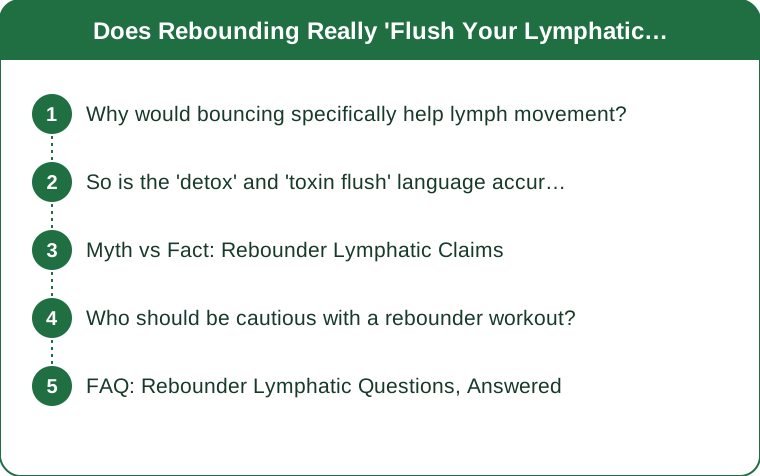
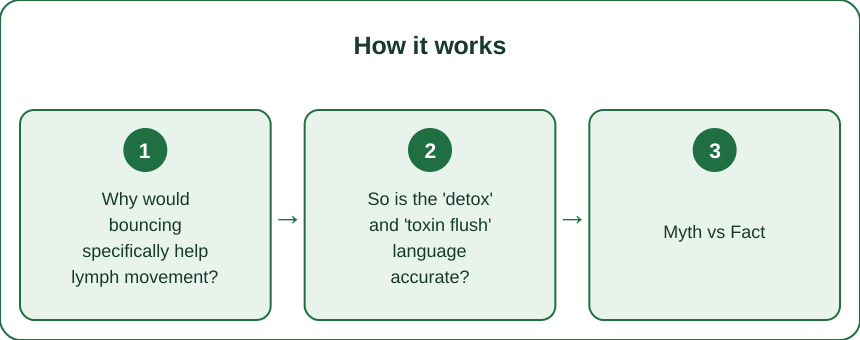
Why would bouncing specifically help lymph movement?
Because your lymphatic system, unlike your circulatory system, has no heart to pump it — it relies entirely on surrounding muscle contraction and one-way valves to move fluid.
The repeated acceleration-deceleration of rebounding (roughly 2x gravity at the bottom of each bounce) creates a rhythmic pressure change that can help push lymph fluid through those valves. This is a legitimate biomechanical effect, documented in exercise physiology, not a wellness-industry invention.
So is the ‘detox’ and ‘toxin flush’ language accurate?
No — that’s where the claim overreaches. Your lymphatic system filters immune-related waste and excess fluid, not a vague category of “toxins.” Better lymph flow can support this filtering process, but it’s not flushing out anything a liver or kidney cleanse claims to remove either.
The honest framing: rebounding supports circulation and lymphatic flow as a mechanical side-effect of a low-impact cardio workout — not a cleansing ritual.

Myth vs Fact: Rebounder Lymphatic Claims
Myth: Any bouncing intensity maximizes lymph flow. Fact: Gentle, controlled bounces (feet barely leaving the mat) engage the mechanism just as effectively as high jumps — intensity isn’t the driver, repetition and consistency are.
Myth: You need 45+ minutes for it to work. Fact: Even 10 minutes of steady rebounding creates the repeated pressure cycling the mechanism relies on — this isn’t a threshold effect.
Myth: Rebounding is uniquely better than walking for lymph flow. Fact: Any rhythmic muscle contraction — walking, cycling, swimming — engages the same valve-pumping mechanism. Rebounding is a low-impact, joint-friendly way to do it, not a uniquely superior one.
Who should be cautious with a rebounder workout?
People with balance issues, severe osteoporosis, or recent joint surgery should get clearance before starting — the unstable surface changes the joint-loading pattern even though impact is low.
If you have a known lymphatic condition like lymphedema, rebounding may genuinely help as light movement, but coordinate the specifics with whoever manages that condition rather than starting solo. This is general information, not medical advice.
FAQ: Rebounder Lymphatic Questions, Answered
How often should I use a mini trampoline for circulation benefits?
Most guidance lands around 10-20 minutes, 3-5 times a week — daily short sessions tend to beat occasional long ones for this specific mechanism.
Can rebounding replace my regular cardio workout?
It can function as legitimate low-impact cardio, especially for joint-sensitive people, but it doesn’t carry unique lymphatic superpowers over other rhythmic movement — pick based on what you’ll actually do consistently.
Is rebounding safe for beginners?
Yes, starting with small, controlled bounces and holding a nearby support the first few sessions. Balance adapts within a couple of weeks for most people.
TL;DR:
- The mechanism is real: your lymphatic system needs muscle movement to circulate, no pump of its own
- ‘Toxin flush’ language overstates it — think circulation support, not cleansing
- Gentle consistent bounces work as well as high jumps; 10 minutes counts
- Any rhythmic movement engages this mechanism — rebounding is just a joint-friendly option
The science underneath is real; just leave the word ‘detox’ out of it.
Keep Reading
This article is for general informational and styling purposes only. Fit, sizing, and product availability may vary.