Rebounder for Weight Loss: 7 Things That Decide Whether It Works
Quick Answer: A rebounder can support weight loss, but only through the same mechanism as any other exercise — energy expenditure plus whatever it does for adherence and appetite. It works for people who use it often enough, hard enough, and long enough, and it does nothing for people who bounce gently for ten minutes while watching television and change nothing else.
The honest version of this question has seven variables in it.
Here they are, ranked by how much each one actually decides the outcome.
This is general information, not medical advice.

1. Whether you are actually working hard enough to matter
This is the biggest variable and the one the marketing obscures.
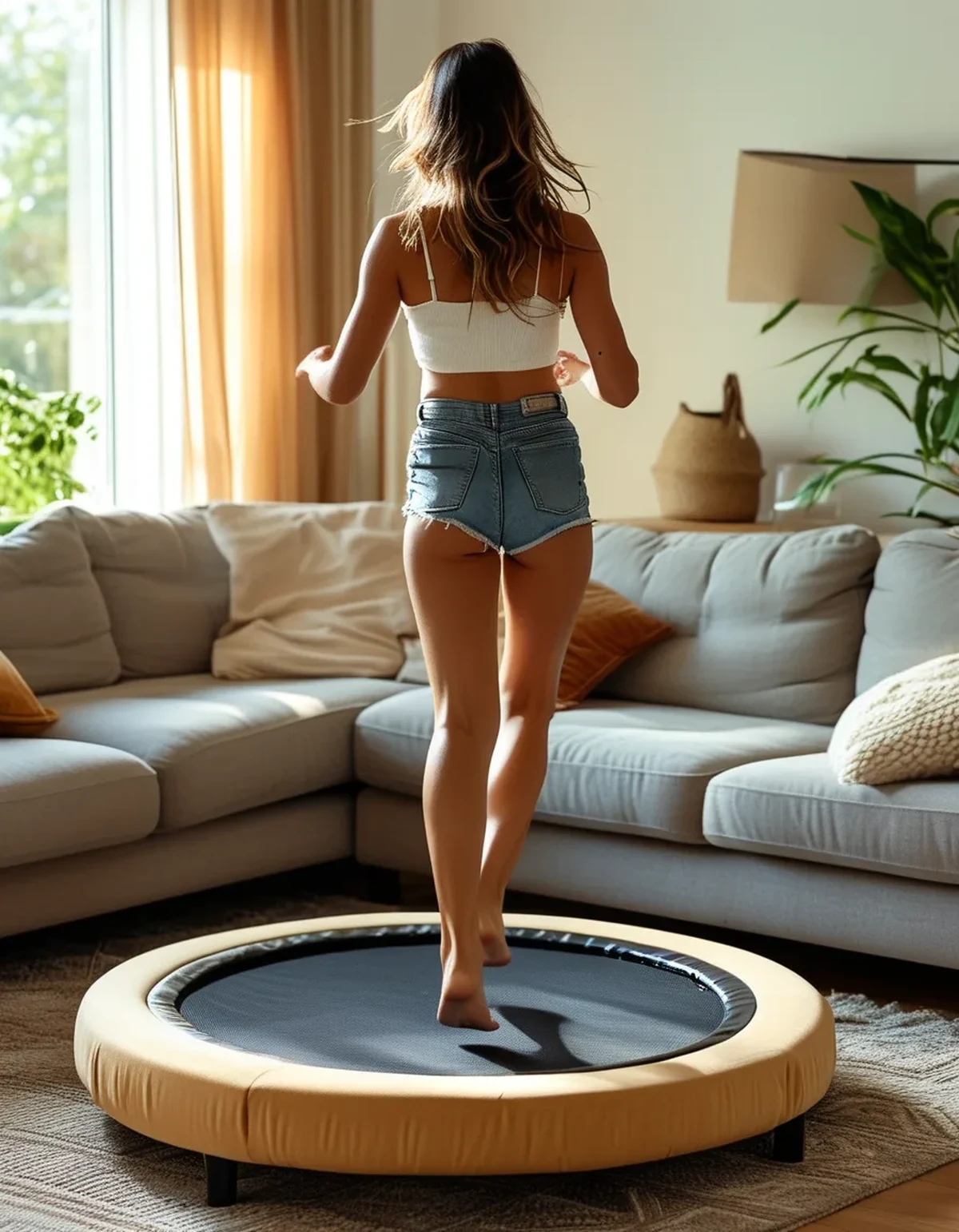
Rebounding has an unusual property: it feels easier than it is at low intensity and easier than it should at high intensity. The elastic surface returns some of your energy on each bounce, so the perceived effort runs below the actual work in a way that walking or running does not.
That cuts both ways. At a gentle health bounce — feet barely leaving the mat — the energy cost is genuinely low, comparable to easy walking. At a real working intensity with high knees, jumping jacks, and continuous movement, it becomes a legitimate cardio session.
Most people who report no results are in the first category and believe they are in the second.
The check: you should be breathing hard enough that talking in full sentences is difficult. If you can hold a normal conversation throughout, the session is a movement break rather than a training session. Both have value; only one moves the energy numbers.
How do I make it harder without more impact?
Higher knees, faster tempo, adding arms, and reducing rest between intervals. All add intensity without increasing landing force.
2. How much of your week it actually accounts for
A rebounder session is typically 10 to 30 minutes, which is one of its main advantages and also the reason it often does not produce results.
Three fifteen-minute sessions a week is 45 minutes of activity. That is genuinely better than nothing and it is a small fraction of a week’s energy expenditure — nowhere near enough to drive weight loss on its own if nothing else changes.
The people who see results from a rebounder generally use it most days, in sessions long enough to matter, on top of a diet that is at least not moving in the wrong direction.
The realistic framing: a rebounder is a tool for accumulating regular moderate activity conveniently, which is a real and underrated thing. It is not a tool that produces weight loss from a small weekly dose.
3. What you do with the rest of the day
This is the variable that quietly decides most outcomes, and it applies to every form of exercise.
Two effects work against you:
Compensatory eating. Appetite often increases after exercise, and it is easy to eat back more than a 20-minute session cost. This is not a failure of willpower; it is normal physiology, and it is more pronounced with sessions that feel harder than they were.
Compensatory resting. People frequently move less for the rest of the day after adding exercise — fewer steps, more sitting. The net change in daily expenditure ends up much smaller than the session suggests.
What helps: tracking steps alongside the rebounder for two weeks. If total daily steps drop on rebounding days, that is the compensation showing up, and it is worth knowing about.
4 and 5: Your starting point and your joints
4. Where you are starting from changes everything
For someone currently sedentary, a rebounder is an excellent entry point — low barrier, at home, weather-proof, and gentle enough to be sustainable. The change from nothing to something regular is the largest single jump in this whole subject, and a rebounder makes that jump easy.
For someone already training four times a week, adding rebounding produces much less, because the marginal effect of one more moderate session is small.
This is why the same device produces enthusiastic reviews and dismissive ones from people who are both being honest.
5. Whether your joints let you go hard enough
The reduced impact compared with running on hard ground is one of rebounding’s genuine advantages, and it is the reason many people with knee or hip issues can do it when they cannot run.
But the advantage only pays off if it lets you work at an intensity you otherwise could not sustain. If joint discomfort still caps you at a gentle bounce, the energy expenditure stays low and the weight-loss case stays weak — while the mobility, balance, and general-health case remains perfectly good.
Be clear about which benefit you are buying.
6 and 7: Consistency and what you are measuring
6. Whether you will still be doing it in three months
Adherence beats optimization by a wide margin, and this is where rebounders genuinely outperform gyms for some people. It is in your house, it takes ten minutes to start, it does not depend on weather or travel, and many people find it more enjoyable than a treadmill.
A moderately effective exercise you do for a year beats an optimal one you quit in five weeks. If a rebounder is the thing you will actually keep doing, that is a serious point in its favour and it belongs in the calculation.
The honest caveat: rebounder enthusiasm has a well-known drop-off around week three to four, once novelty fades. If you are buying one, plan for that week specifically — a structured programme, a class, or a fixed schedule.
7. What you are counting as success
If the only metric is scale weight, a rebounder will often look like a failure even when it is working. Regular moderate exercise improves cardiovascular fitness, balance, mood, and sleep well before it changes body weight — and it can build a small amount of muscle in the legs, which offsets fat loss on the scale.
Better measures: how long you can sustain a working intensity, how you feel on the stairs, waist measurement, and how clothes fit. Those move earlier and more reliably, and they are measuring the things that actually improved.
What nobody tells you about rebounders and weight loss
The lymphatic claim does not do what the marketing implies. Movement does support lymphatic flow, and this is true of all movement — walking, swimming, stretching. There is no established mechanism by which rebounding specifically produces weight loss through the lymphatic system, and claims framing it as a detox effect are not supported.
Calorie estimates for rebounding vary enormously, which is why you see wildly different numbers quoted. The range reflects genuine variation in intensity, not a measurement problem. Whatever number a website gives you, your actual session could be a third of it or double.
A cheap rebounder changes the workout. Springs that are too stiff or a mat that is too taut reduce the range of movement and make the session both harder on the joints and less effective. Bungee-based models are generally quieter and softer. This is one of the few cases where equipment quality genuinely changes the exercise.
The first month is mostly your calves. Soreness concentrated in the calves and feet is normal early and generally settles. If it persists past a few weeks, look at landing technique — most people land too far forward on the toes.
Cold rooms change the springs. As the weather turns, an unheated room makes the mat and springs stiffer, and sessions feel different for no apparent reason. It is worth a longer warm-up rather than a conclusion about your fitness.
FAQ: Rebounder Weight Loss Questions, Answered
How long should a session be for weight loss?
Long enough to accumulate meaningful work — commonly 20 to 30 minutes at an intensity where conversation is difficult, most days. Shorter sessions still have health value; they just contribute less to energy balance.
Is rebounding better than walking for weight loss?
At matched intensity and duration, the differences are modest, and the better one is whichever you will actually do consistently. Rebounding is more convenient in bad weather; walking is easier to sustain for long durations.
Will it help with belly fat specifically?
No exercise targets fat loss from a specific area — that is one of the most consistently debunked ideas in fitness. Overall energy balance determines fat loss, and where it comes off is largely individual.
Do I need to change my diet too?
For weight loss specifically, diet does most of the work for most people. Exercise supports it, improves how the process feels, and helps preserve muscle. Expecting exercise alone to do it is the most common reason people conclude a device does not work.
Is it suitable if I have pelvic floor concerns?
Repeated bouncing is a loading activity and it is a common concern, particularly postpartum. This is worth raising with a pelvic health physiotherapist before starting rather than after.
TL;DR:
- Intensity is the biggest variable — if you can hold a conversation throughout, it is a movement break, not a training session.
- Short sessions a few times a week will not move energy balance on their own.
- Compensatory eating and moving less afterwards quietly cancel a lot of the gain.
- Starting point matters: large effect if you are sedentary, small effect if you already train.
- Adherence is the rebounder’s real advantage; plan for the week-three drop-off.
- Measure sustained intensity, waist, and how clothes fit rather than scale weight alone.
A rebounder is a legitimate cardio tool with an unusually good adherence profile. It is not a mechanism that produces weight loss on its own, and the people it works for are the ones who used it like exercise.
This is general information, not medical advice.
Keep Reading
This article is for general informational and styling purposes only. Fit, sizing, and product availability may vary.