Buying a Mini Trampoline: The Rebounder Features That Matter and the Ones That Don't
Quick Answer: The only decision that really matters is bungee vs spring. Bungee cords give a deeper, softer, near-silent bounce and suit joint-sensitive, heavier or older bouncers — and cost more. Steel springs give a firmer, snappier bounce for less money, and eventually squeak. Beyond that: 40 inches fits most people, treat the listed weight rating as 20% higher than what you should plan for, check your ceiling clearance, and expect to spend $150–300 for something you’ll use regularly.
Rebounders run from $40 to $600, which looks like a marketing spread and isn’t. The gap is the bounce itself — how the mat decelerates you, whether it squeaks through your downstairs neighbor’s ceiling, and whether the thing survives three years of daily use.
Get one decision right and the rest is detail.
Bungee or spring: which rebounder should you buy?
Bungee (elastic cord) rebounders suspend the mat on woven cords. The bounce is deeper and slower — you sink further and get decelerated gently, which is exactly what joint-sensitive users want. They’re also near-silent, which matters enormously in an apartment. The trade is price: bungee models generally start where spring models end.
Spring rebounders use steel springs for a firmer, faster, more athletic rebound. If you want class-style cardio with quick footwork, the snap is genuinely preferable. They’re cheaper, and they develop a squeak over time that needs occasional lubrication.
The feel difference is real and personal: bungee is marshmallow-deep, spring is quick trampoline snap. Bounce on both before you buy if you possibly can — a store, a studio, a friend’s living room. Ten seconds tells you more than ten reviews.
Two rules that settle most cases:
- Joint-sensitive, heavier, or older bouncers → bungee. The soft deceleration is the reason to buy a rebounder in the first place.
- Match it to your intended use. Gentle health-bounce and lymphatic-style sessions want bungee depth. HIIT-style rebounding classes work fine on either.
Which features actually matter?
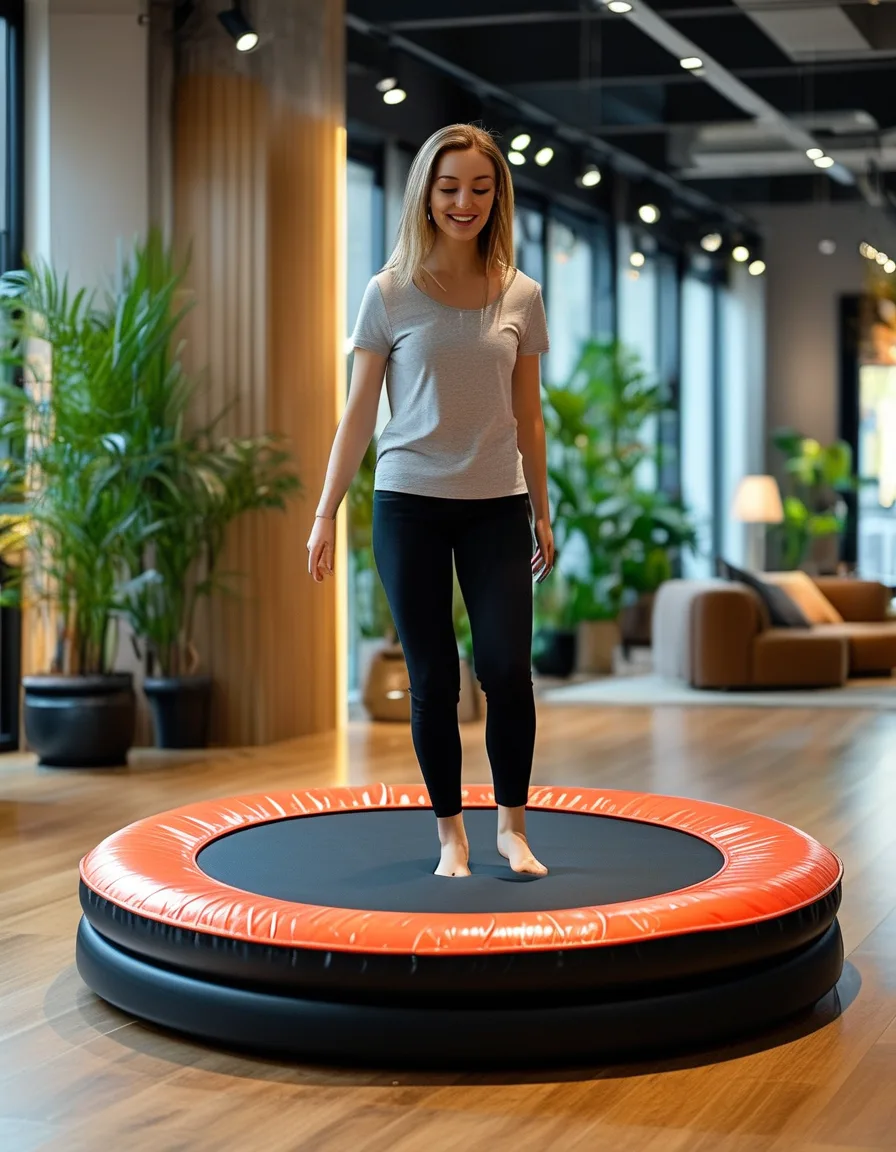
Diameter. 40 inches is the standard and serves most people. Go 48+ if you’re tall or your workouts involve travelling around the mat. What matters is the usable mat surface, not the frame measurement — some 40-inch frames have noticeably smaller mats than others.
Weight rating, read honestly. Take the listed limit and subtract about 20% as your working number. Bouncing multiplies your effective load well beyond your body weight, and a rating quoted for static weight isn’t describing what you’re about to do to it. Frame gauge and welding quality sit behind that number.
Legs. Screw-in legs are more stable; folding mechanisms let you store it flat, which is often what makes it viable in a small apartment. Hinges are a real stability trade-off — accept it knowingly rather than discovering it.
Stability bar. A T-bar is genuinely useful for beginners, anyone balance-cautious, and older users — it’s confidence scaffolding for the first month. Buy a model with a removable bar so you can retire it later.
Mat and stitching. Look for UV and wear ratings, and prefer brands that sell replacement parts. A rebounder you can re-cord for $40 in year four is a much better purchase than one you replace.
Ceiling clearance. Do the math before you buy: your height + bounce height (6–12 inches) + arm reach if you use your arms. Standing on an 8-inch-high mat with a 9-foot ceiling leaves less room than you think.
Warranty. Check whether the frame and the parts are covered separately. Bungee cords are consumables — plan on replacing them every few years — so cord availability matters more than cord warranty.

What does each price tier actually buy?
Under $100. Legitimate for testing whether you’ll stick with it, and for light use. Expect springs, a smaller mat, and a shorter lifespan. Check the weight rating and wobble carefully here — this is the tier where those go wrong.
$150–300 — the sweet spot. Quality springs or entry-level bungees, better mats, folding options. This is where most buyers should land for regular use.
$300+. Studio-grade bungee models with decade-long lifespans and a proper parts ecosystem. Justified if you bounce most days or if joint comfort is the whole point — the cost per session gets small quickly.
The used market is unusually good. New Year’s-resolution rebounders show up barely used every spring. Inspect the frame for bends, the mat for stitching wear, and bounce-test it. On bungee models, ask how old the cords are — they degrade with age even unused.
Skip: bounce-counting gadgets and branded workout subscriptions. There is a large free ecosystem of rebounding workouts, and the counter on the handle will bore you in a week.
How should you set it up and start?
Give it a permanent spot. The visible rebounder is the used rebounder — folded behind a door, it becomes furniture. Near the TV is the highest-adherence placement there is.
Put a mat underneath. It protects your floors, adds grip, and cuts the transmitted thud for anyone below you.
Week one is the health bounce. Feet never leave the mat — you’re just pressing down and letting it push back. This looks like nothing and is genuinely the right starting point, because your balance system needs a week to adapt before you start jumping. Ten-minute sessions.
Safety basics: bounce in the center, barefoot or in grip socks (regular socks slide), keep the surrounding area clear, and supervise kids without exception.
Maintenance: check bolt tightness and inspect cords or lubricate springs quarterly. It takes five minutes and roughly doubles the useful life.
Myth vs Fact
Myth: A cheap rebounder bounces the same, it just looks worse. Fact: The suspension is the product. A $40 rebounder with stiff short springs delivers a shallow, jarring bounce — the opposite of what makes rebounding joint-friendly.
Myth: Bigger is better. Fact: A 48-inch model in a room where you have to move a chair to use it will get used less than a 40-inch one that lives out permanently. Fit the space first.
Myth: Rebounding is only gentle, low-effort exercise. Fact: Health bounces are gentle by design, but interval rebounding gets your heart rate up quickly. The same tool covers both ends.
Myth: The stability bar is for people who can’t balance. Fact: It’s for the first four weeks of everyone’s rebounding, and permanently useful for single-leg work. Removable is the answer, not absent.
Mini FAQ
What size mini trampoline should I buy?
40 inches for most adults in most rooms. Choose 48+ if you’re over about 5’10”, if your workouts involve moving around the mat, or if you want extra margin for balance. Measure your intended spot and your ceiling before ordering — returns on these are a genuine hassle.
Are bungee rebounders worth the extra money?
If you have sensitive knees, ankles or a back, live in an apartment, or plan to bounce most days — yes, comfortably. If you’re testing the waters, want a snappy athletic bounce, or are on a tight budget, a good spring model at $150–250 is a perfectly sound purchase.
How much weight can a rebounder hold?
Most list 220–300 lbs, with premium models rated higher. Plan for about 20% below the listed number, since bouncing generates forces well above static body weight. If you’re near the limit, that’s the strongest argument for a bungee model with a heavy-gauge steel frame.
TL;DR:
- Bungee = deep, soft, silent, pricier — best for joints and apartments. Spring = snappy, cheaper, eventually squeaks.
- 40 inches suits most; check usable mat, not frame size.
- Treat the weight rating with a 20% margin.
- Measure ceiling clearance: your height + 12 inches + arm reach.
- Spend $150–300 for regular use; buy brands that sell replacement parts.
- Week one = health bounces, feet on the mat, 10 minutes.
Buy the bounce, not the accessories — one good rebounder lasts a decade.
Keep Reading
This article is for general informational and styling purposes only. Fit, sizing, and product availability may vary.