Rebounding: The Mini Trampoline Workout That Feels Like Cheating
Some workouts you endure; rebounding you have to be told to stop. Bouncing on a mini trampoline — yes, the thing that looks like a toy — delivers legitimate cardio, lymphatic circulation and leg strength at a fraction of the joint impact of running. NASA studied it for astronauts and came away impressed. Your downstairs neighbors will hear nothing. Your inner child will hear everything.

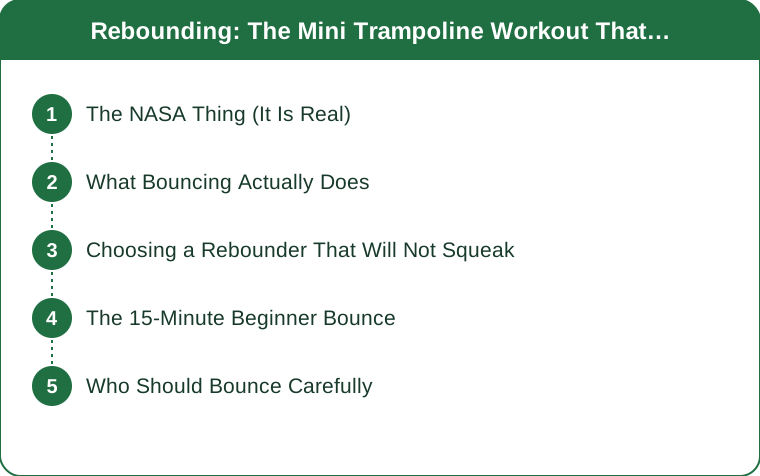
The NASA Thing (It Is Real)
In a 1980 study, NASA researchers compared trampoline bouncing to treadmill running and found rebounding produced comparable oxygen consumption with far lower impact forces — useful for rebuilding astronauts after zero gravity. The mat absorbs up to 80% of the shock your joints would otherwise eat on pavement. Translation for earthbound women: running-adjacent cardio that your knees, hips and pelvic floor experience as a gentle suggestion rather than an assault.
What Bouncing Actually Does
Every bounce is a full-body event: legs and glutes drive, core stabilizes against the wobble, and the rhythmic up-down uniquely encourages lymphatic flow — your body’s drainage system, which has no pump of its own and relies on muscle movement. Balance improves fast because the unstable surface trains your ankles and reflexes on every landing. And the mood effect is absurd: it is biomechanically difficult to bounce and stay grumpy.

Choosing a Rebounder That Will Not Squeak
The $40 spring models squeak, sag and teach you to hate this. A quality bungee-cord rebounder ($100–150) bounces silently and smoothly and lasts a decade — the single upgrade worth making. Look for 40 inches or wider, a weight rating comfortably above yours, and a stability handle if balance is a concern. Barefoot or grippy socks work best. Apartment dwellers: bungee models are genuinely downstairs-neighbor-proof.
The 15-Minute Beginner Bounce
Start with the health bounce — heels stay on the mat, gentle pulse — for 2 minutes. Then rotate through: 1 minute basic bounce, 1 minute jumping jacks, 1 minute high-knee march, 1 minute twist bounce (hips rotate, arms counter), 1 minute health bounce recovery. Repeat the cycle twice and finish with a slow bounce cooldown. Music transforms it — build a playlist at roughly 125–130 BPM and the workout paces itself.
Who Should Bounce Carefully
Rebounding is famously gentle, but a few groups should ease in: new moms should clear it with their pelvic-floor timeline first (start with the heels-down health bounce), and anyone with balance concerns should use a handle bar. Start with 5–10 minutes; your stabilizer muscles are working even when it feels like play. That post-bounce calf-and-core awareness the next morning is the receipt for how much actually happened.
Rebounding is what happens when exercise forgets to be miserable: real cardio, real lymph flow, real leg strength, zero dread. Put a quality rebounder where the TV lives, bounce through one show a day, and let the least serious-looking equipment in your house quietly become the most used. Fifteen minutes. Neighbors none the wiser. Joy levels: unreasonable.
Keep Reading
This article is for general informational and styling purposes only. Fit, sizing, and product availability may vary.