7 Things That Happen to Your Joints in the First Month of Rebounding
Quick Answer: In the first month of rebounding, joints typically go through a predictable adaptation curve — mild ankle and knee stabilizer soreness in week one, improving balance and proprioception by week two to three, and noticeably reduced perceived impact by week four, as the surrounding stabilizing muscles catch up to the unfamiliar unstable surface.
The trampoline itself absorbs a lot of impact — that part of the marketing is true. What doesn’t get mentioned as often is what the first few weeks actually feel like while the ankles and knees adjust to a moving surface for the first time.

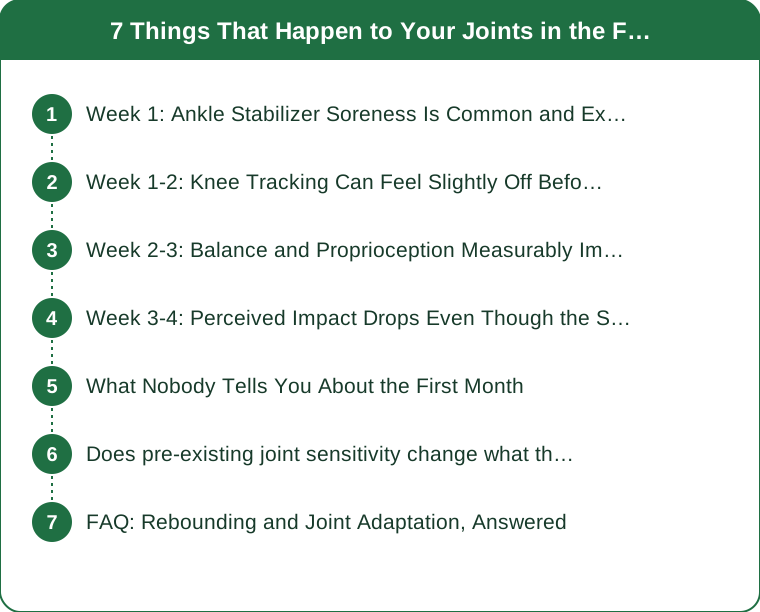
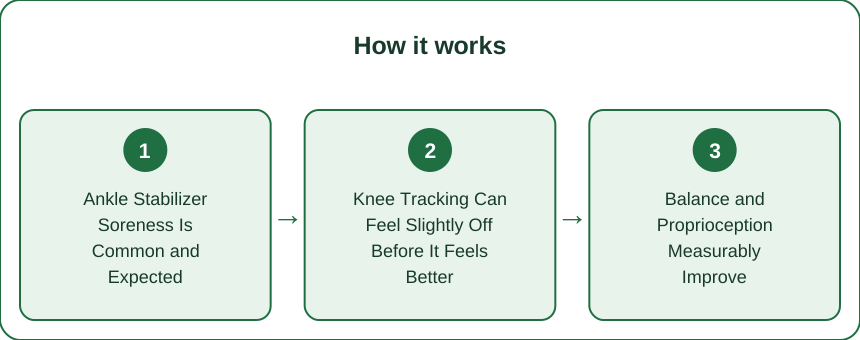
Week 1: Ankle Stabilizer Soreness Is Common and Expected
The ankle has to make constant micro-adjustments on a moving, unstable mat surface that a stable floor never requires, and the small stabilizing muscles around the ankle joint are rarely trained directly by most other workouts, so mild soreness in the first week — distinct from joint pain — is a normal sign those stabilizers are being worked for possibly the first time.
Week 1-2: Knee Tracking Can Feel Slightly Off Before It Feels Better
Because the rebounder surface moves beneath the foot on landing, the knee has to make small tracking corrections mid-movement that don’t happen on a fixed floor, and some people notice a brief, mild sense of the knee feeling less stable during this adjustment period — this typically resolves as the surrounding hip and thigh stabilizers strengthen to match the new demand, usually within the first two weeks for most beginners.
Week 2-3: Balance and Proprioception Measurably Improve
By the second to third week, most beginners notice landings feel more controlled and less wobbly, which reflects genuine neuromuscular adaptation — the nervous system getting faster and more accurate at reading the unstable surface and adjusting joint position in real time, a skill that continues improving with continued use and also tends to carry over into better balance on stable ground.

Week 3-4: Perceived Impact Drops Even Though the Surface Hasn’t Changed
The rebounder mat’s actual impact absorption stays constant, but many people report the workout feeling noticeably ‘softer’ or lower-impact by the third or fourth week — this is largely because the stabilizing muscles around the ankle, knee, and hip have adapted enough to control landings more efficiently, reducing the amount of jarring, uncontrolled force that reaches the joint itself, rather than the trampoline becoming physically softer.
What Nobody Tells You About the First Month
Most rebounder marketing presents the low-impact benefit as immediate and automatic from day one, but the joint-protective effect is partly something that builds over the first month as stabilizing muscles adapt — someone jumping onto a rebounder for the first time with weak ankle stabilizers may not get the full low-impact benefit until several weeks in, meaning the ‘gentle on joints’ claim is more accurate as a description of week four than week one for most true beginners.
Does pre-existing joint sensitivity change what this first month looks like?
Yes — someone with existing knee or ankle sensitivity may need a slower ramp-up (starting with smaller, more controlled bounces rather than higher-intensity jumping) to avoid the early adaptation soreness tipping into actual irritation, and should watch for the difference between normal muscular fatigue soreness and any sharp or persistent joint pain, which is a signal to scale back regardless of what week it is.
FAQ: Rebounding and Joint Adaptation, Answered
Is week-one ankle soreness from rebounding something to push through?
Mild, dull stabilizer soreness that fades within a day or two is generally fine to continue through at a reduced intensity, but any sharp joint pain or soreness that worsens rather than improves over the week is a signal to scale back and consult a professional if it persists.
How long until rebounding actually feels as low-impact as advertised?
Most consistent beginners notice a meaningfully lower perceived impact by the three-to-four-week mark, once ankle, knee, and hip stabilizers have adapted enough to control landings more efficiently.
Should someone with existing joint issues start rebounding differently than a healthy beginner?
Yes — starting with smaller, slower, more controlled bounces and progressing gradually rather than jumping straight into higher-intensity intervals reduces the risk of early adaptation soreness becoming actual irritation, and checking with a doctor or physical therapist first is worth doing for anyone with existing joint conditions.
TL;DR:
- Ankle stabilizer soreness in week one is a normal sign of new muscle recruitment, not injury
- Knee tracking can briefly feel less stable before stabilizing muscles catch up, usually within two weeks
- Balance and proprioception measurably improve by weeks two to three
- The ‘gentle on joints’ effect builds over the first month as stabilizers adapt, rather than being immediate
This is general information, not medical advice — persistent or sharp joint pain should be evaluated by a professional. The first month of rebounding is an adaptation period more than an instant low-impact fix, and knowing that going in makes the early wobbly weeks feel like progress instead of a warning sign.
Keep Reading
This article is for general informational and styling purposes only. Fit, sizing, and product availability may vary.