7 Things That Change About Rebounding Once the Room Turns Cold
Quick Answer: Cold stiffens both the bungees or springs and the mat itself, which raises the effective tension and shortens your bounce. Your own tissue is also colder and less compliant. Ten extra minutes of warm-up and a lower first five minutes of intensity restores nearly all of it.
The same rebounder, the same routine, and it suddenly feels like someone changed the settings.
Nobody did. The room went from 74 degrees to 62, and a rebounder is a temperature-sensitive machine.
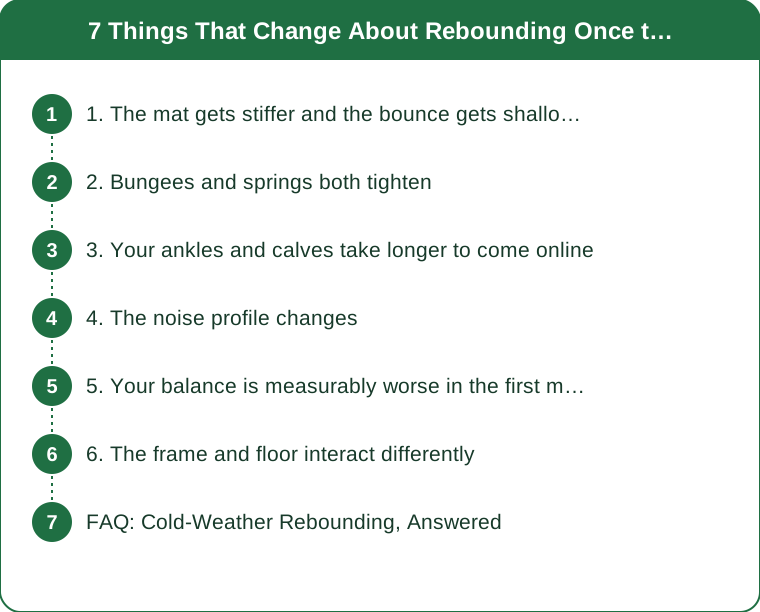
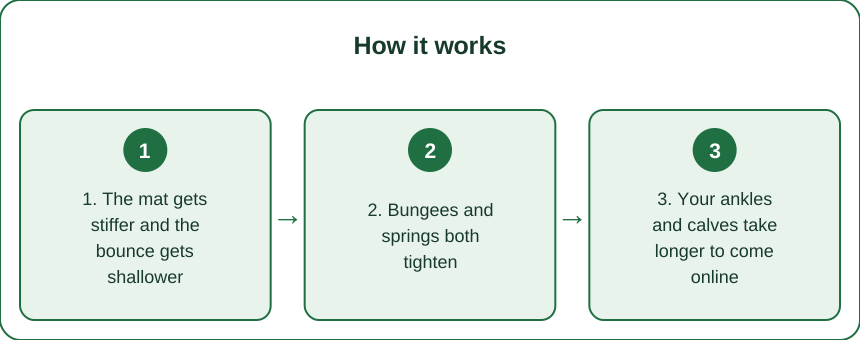
1. The mat gets stiffer and the bounce gets shallower
Permatron and similar mat materials lose elasticity as temperature drops. A cold mat returns less energy, so the same effort produces a lower bounce and the session feels like more work for less height.
Expect the first five minutes to feel noticeably harder. The mat warms from your own repeated impact and reaches something close to its usual behavior after about 8 to 10 minutes of continuous use.
2. Bungees and springs both tighten
Steel springs stiffen modestly in cold. Bungee cords, which are elastomer-based, stiffen considerably more — a bungee rebounder in a 60-degree room can feel a full tension setting firmer than it did in August.
If your rebounder has adjustable tension, dropping one setting for the winter months is a legitimate adjustment rather than a compromise. Return it in spring.
3. Your ankles and calves take longer to come online
Rebounding is almost entirely an ankle and calf activity in its first minutes. Cold tendons are stiffer and less compliant, which means the Achilles absorbs less and passes more load to the calf muscle itself.
That is the reason for calf soreness after a session that felt easy. Five minutes of calf raises and ankle circles before you step on solves most of it.
4. The noise profile changes
Cold, dry air and a stiffer mat produce a sharper, higher-frequency sound on each contact. At the same time, your neighbors have closed their windows and lost the outdoor noise that was covering you all summer.
Nothing about your session got louder, but the room is more reverberant and the acoustic background dropped. A rubber mat under the frame and a session moved into the building’s busier hours handles both.
5. Your balance is measurably worse in the first minutes
Cold reduces the sensitivity of the mechanoreceptors in the feet and ankles that supply balance information. On an unstable surface, that shows up immediately as more wobble and more corrective movement.
This is the single best argument for a genuine warm-up rather than a token one. Balance work — single-leg holds, health bounces — belongs at minute ten, not minute one.
6. The frame and floor interact differently
Wooden floors contract in dry heated air, opening small gaps and increasing creak. Rubber feet also harden in cold, which transmits more vibration into the floor rather than absorbing it.
A dense mat under the rebounder addresses both at once. It is a bigger difference than most people expect from a single piece of rubber, and it is the cheapest fix on this list.
7. Session structure needs to change, not session length
The instinct is to shorten the workout because it feels harder. The better adjustment is to reallocate: 10 minutes of warm-up instead of 3, then the same work, then a shorter cool-down.
A useful winter structure is 10 minutes of health bounces and mobility, 20 minutes of the actual session, and 5 minutes easy. Total time rises by about 7 minutes and the session quality returns to where it was in summer.
If you have an existing ankle, knee, or back issue, or you notice joint pain that does not settle after a warm-up, get it assessed rather than training through it. This is general information, not medical advice.
FAQ: Cold-Weather Rebounding, Answered
Should I change my spring or bungee tension in winter?
If it is adjustable, dropping one setting compensates well for cold-related stiffening, particularly on bungee models where the effect is largest. Return it when the room warms up. If the tension is fixed, extending the warm-up achieves most of the same result.
Why do my calves hurt more after cold-room sessions?
Cold tendons are stiffer, so the Achilles stores and returns less energy and the calf muscle handles more of the work. Five minutes of calf raises and ankle circles beforehand meaningfully reduces it, and the effect disappears once the room and your tissue are warm.
Does rebounding damage the mat in a cold room?
Not at typical indoor temperatures. Below about 40 degrees Fahrenheit — an unheated garage in deep winter — mat and bungee materials become brittle enough that wear accelerates. A heated room is fine; an unheated garage in January is genuinely worth avoiding.
TL;DR:
- Cold stiffens the mat and the bungees, so the bounce is shallower and the effort is higher for the first ten minutes.
- Drop one tension setting if adjustable, and warm the calves and ankles before stepping on.
- Balance is worse when cold — move single-leg work to minute ten rather than minute one.
- Add a dense mat under the frame: it handles both floor vibration and the noise your neighbors newly hear.
The rebounder did not change over the weekend. It is simply a machine made of elastic materials, and elastic materials have opinions about temperature.
Keep Reading
This article is for general informational and styling purposes only. Fit, sizing, and product availability may vary.