7 Things That Change About Rebounding in Winter
Quick Answer: Cold makes the springs or bungees of a rebounder stiffer and the mat less elastic, so the bounce is genuinely lower and harder. Your own tissue is stiffer too, meaning a shorter warm-up produces a harsher landing. Add drier air, a room that has shrunk with winter clutter, and a rebounder stored somewhere cold, and the same session feels worse. All seven have straightforward fixes.
Same rebounder, same twenty minutes.
In July it felt springy. In January it feels like jumping on a table.
The equipment changed, and so did you.
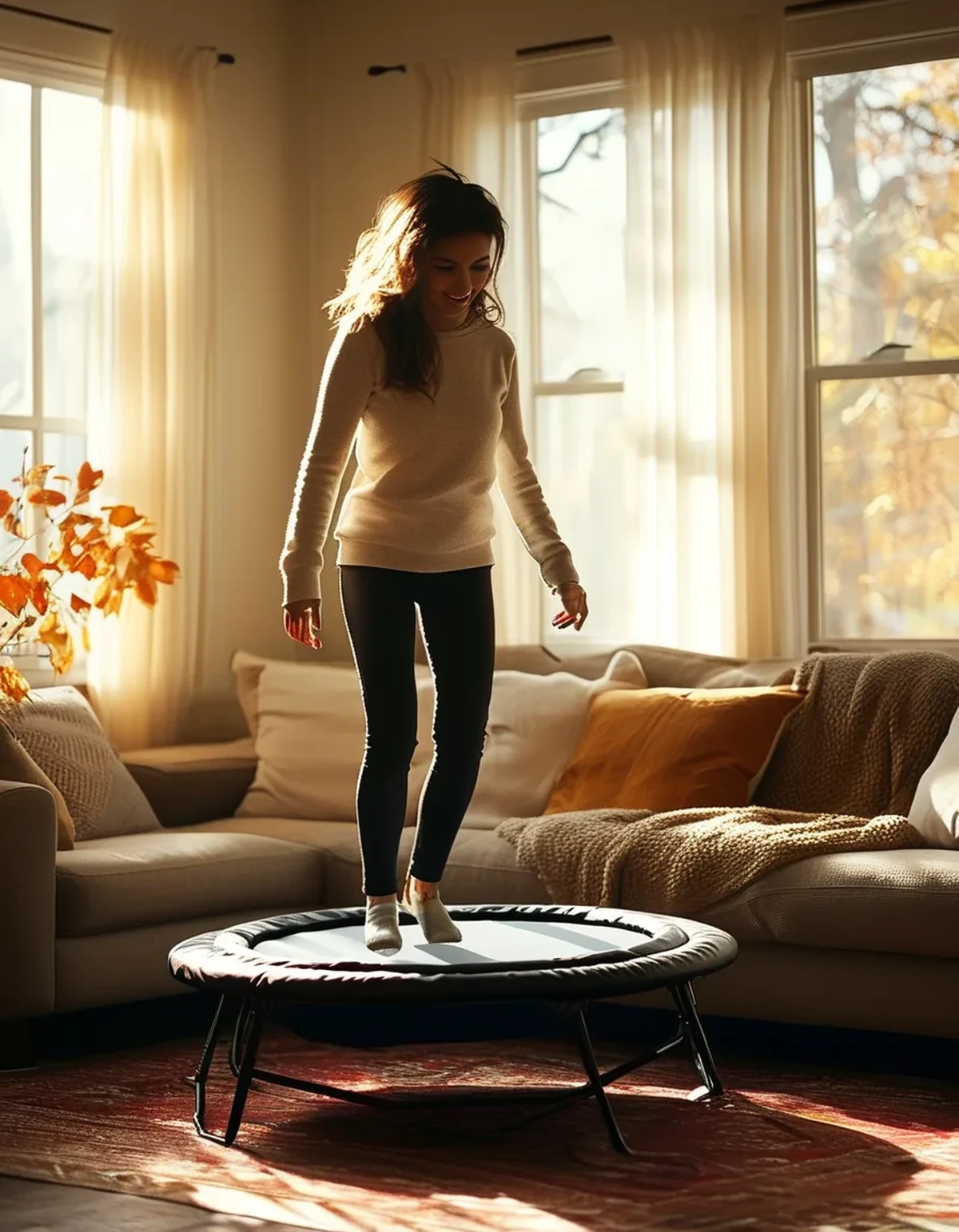
1 and 2. The rebounder itself is stiffer in the cold
1. The springs get stiffer in the cold
This is a genuine material property, not a perception.
Steel springs become slightly stiffer as temperature falls, and bungee cords change considerably more because rubber and elastomer stiffness is strongly temperature-dependent.
A bungee rebounder stored in a cold room is noticeably firmer for the first several minutes of use, softening as it warms with movement.
The practical effect is a lower, harder bounce for the same effort, which increases the impact transmitted through your legs.
Fix: let the rebounder warm to room temperature before use, and spend the first three minutes at a low, gentle bounce that warms the cords as much as it warms you.
2. The mat is less elastic
The jumping surface has its own temperature behaviour.
Woven polypropylene mats lose a small amount of stretch in cold conditions, contributing to the flatter feel.
A cold mat also feels harder underfoot, which changes how you land whether or not the mechanics have changed much.
Fix: same as the springs — warm the room, warm the equipment, and start gently. Storing the rebounder in the living space rather than a garage or conservatory solves it permanently.
3. Your tissue is stiffer and needs a longer warm-up
The person is more temperature-sensitive than the equipment.
Cooler muscle is less compliant and absorbs impact less well, and rebounding is fundamentally an impact-absorption activity even though the impacts are gentle.
Ankles and calves are the first to complain, because they do most of the absorbing.
Cold morning sessions are the worst case, since core temperature is at its daily low.
Fix: five minutes of gentle health bounce — feet staying on the mat — before anything with air time. Double the summer warm-up rather than matching it.
4. The room got smaller
Winter reduces usable space in ways that affect technique.
Drying laundry, heaters, and general indoor clutter reduce clearance around the rebounder, and a rebounder needs genuine overhead and side clearance.
Reduced space produces a more cautious, tighter bounce, which is less effective and more jarring than a full one.
Ceiling height is the constraint people forget, particularly with arms overhead.
Fix: measure once and clear a fixed footprint. Two metres of clearance around and enough height to raise your arms fully — and if the space genuinely is not there, a lower bounce with more time is a better adaptation than a cramped high one.
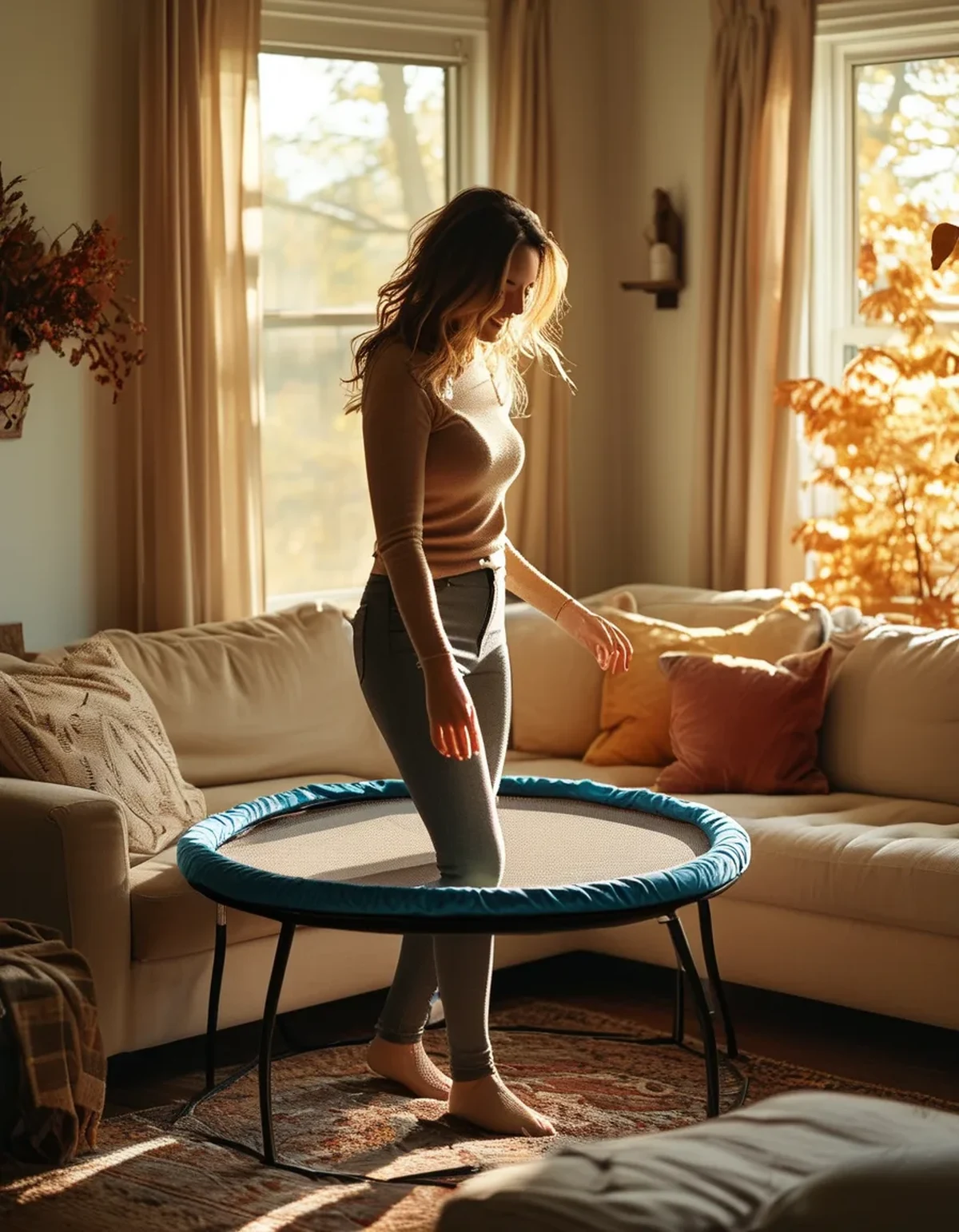
5. The floor underneath behaves differently
Flooring and noise both change with the season.
Cold hard flooring transmits more vibration than warm carpet, and winter often means training on a floor rather than outdoors.
Neighbours are indoors more and windows are shut, so the same noise is more noticeable.
Low-frequency vibration travels through building structure far better than airborne sound, which is why a rebounder is heard downstairs.
Fix: a dense rubber mat under the rebounder makes a real difference, and keeping to health bounce — where feet stay in contact with the mat — removes most of the impact entirely while retaining much of the benefit.
6. Dry air changes the feel and the equipment
Heated indoor air is much drier than summer air.
Low humidity accelerates the ageing of rubber and elastomer components, so bungee rebounders stored in heated rooms degrade slightly faster.
Dry air also affects you — you dehydrate faster than expected indoors in winter because sweat evaporates quickly and you feel less thirsty in the cold.
Static and dust are minor but real annoyances in a dry room.
Fix: check bungees or springs monthly for wear — look for fraying, uneven tension, or a bounce that has become asymmetric — and drink during sessions even though you do not feel like it.
7. Motivation and consistency both change
The seventh is behavioural and it is the one that actually decides outcomes.
Reduced daylight is associated with lower activity levels and lower mood in a substantial minority of people, and a home cardio option is exactly the thing that should benefit — if it is set up.
Setup friction is the deciding variable. A rebounder that lives folded in a cupboard gets used far less than one standing ready, and in winter the difference is larger because motivation is lower.
Short sessions beat planned long ones. Ten minutes done four times a week beats thirty minutes planned twice and done once.
Fix: leave it out, leave the shoes or the mat beside it, and set the bar at ten minutes. Rebounding’s advantage over every other winter cardio option is that it requires no weather assessment and no travel — which only pays off if the setup cost is near zero.
And the honest caveat: rebounding is a moderate-intensity activity for most people, useful for general movement, balance, and consistency rather than as a high-intensity substitute. If you have joint problems, balance concerns, or a pelvic floor issue, speak to a physiotherapist about whether and how to rebound — this is general information, not medical advice.
FAQ: Winter Rebounding Questions, Answered
Where should I store a rebounder over winter?
In a heated part of the home, ideally set up. A garage, conservatory, or shed exposes it to cold and humidity swings that age bungees and springs faster, and it guarantees a cold, hard first session. If it must be stored folded, bring it into the room half an hour before using it.
How do I know when the bungees or springs need replacing?
Look and listen. Visible fraying, rust, a spring that has lost its close-coiled shape, or a bounce that feels uneven side to side all mean replacement. Most manufacturers suggest replacing bungees every one to two years with regular use, and it is far cheaper than a new rebounder.
Is a health bounce actually worth doing, or is it too easy?
It is worth doing and is the correct starting point. Keeping the feet in contact with the mat still produces the repeated acceleration and deceleration that makes rebounding useful, while removing almost all the impact and noise. It is also the right version for anyone returning to exercise, managing a joint issue, or living above a neighbour.
Can rebounding replace outdoor cardio in winter?
As a consistency tool, largely yes. It delivers moderate-intensity movement with no weather dependency and minimal setup, which is precisely what winter removes. What it does not replace is the daylight exposure, which matters for mood and sleep — so pair it with a short outdoor walk rather than treating it as a full substitute.
TL;DR:
- Cold stiffens springs and especially bungees, producing a lower, harder bounce for the same effort.
- The mat loses elasticity too, and your own tissue is stiffer and absorbs impact less well.
- Warm the equipment and the room, then double your summer warm-up with a gentle health bounce.
- Winter clutter shrinks clearance; measure and clear a fixed footprint rather than bouncing cautiously.
- A dense rubber mat underneath addresses most of the downstairs noise problem.
- Check bungees and springs monthly, and replace them every one to two years with regular use.
- Leave it set up — setup friction, not motivation, is what decides winter consistency.
Warm the room, warm the rebounder, and set the bar at ten minutes, and the corner of the living room beats the weather all winter.
Keep Reading
This article is for general informational and styling purposes only. Fit, sizing, and product availability may vary.