7 Signs Your Rebounder's Spring Tension Is Wrong for Your Body
Quick Answer: Spring tension that’s too tight feels stiff and jarring on the joints, while tension that’s too loose feels bottomless and unstable — both signs point to a mismatch with your body weight and bounce intensity that a quick adjustment or spring swap can usually fix.
Most rebounders come with one fixed spring tension, but that single setting doesn’t work equally well for every body and every workout style.

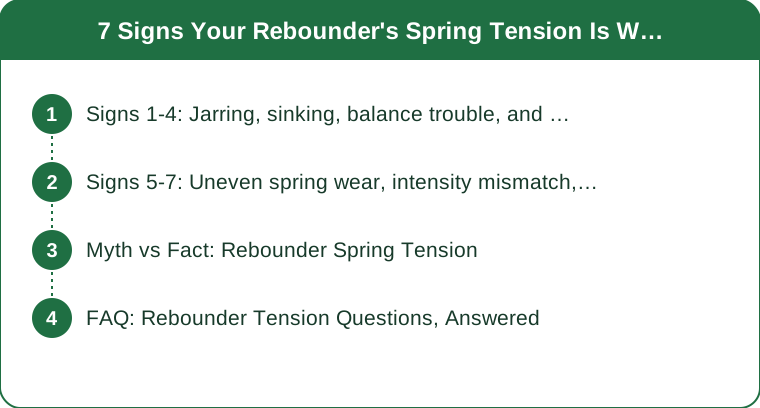
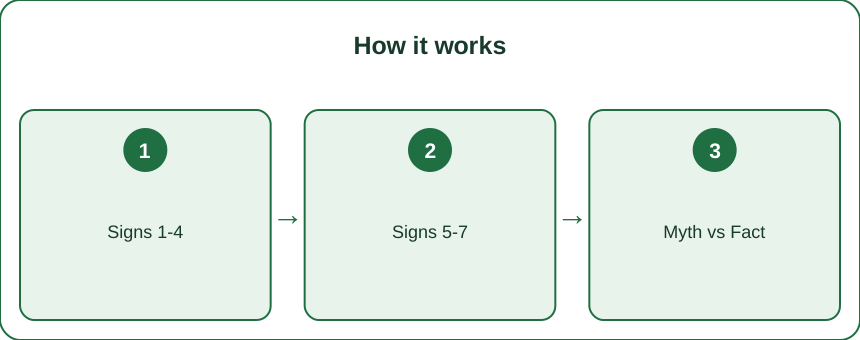
Signs 1-4: Jarring, sinking, balance trouble, and extra effort
1. Your knees or ankles feel jarred with every landing
If tension is too tight for your body weight, the mat doesn’t absorb enough force on landing, sending more impact back up through your joints than a properly tensioned mat would. This is one of the clearest signs the spring rate needs to come down.
2. You feel like you’re sinking to the frame on harder bounces
Tension that’s too loose lets you bottom out, especially during higher-intensity moves, which not only feels unstable but can reduce the elastic rebound effect that makes the workout effective in the first place.
3. Your balance feels off in a way that wasn’t there when you started
A mat that’s too loose for your weight can create unpredictable rebound timing, since the mat’s response varies more with an uneven tension setup — your brain can’t anticipate the bounce the same way each time, which shows up as balance trouble.
4. Basic bounces feel like more effort than they should
If tension is too tight, you’re doing more work just to get the same bounce height, since a stiffer mat returns less energy. This can make a workout feel unusually exhausting even at a beginner intensity.
Signs 5-7: Uneven spring wear, intensity mismatch, and weight range
5. You hear or feel uneven spring response around the mat
Springs wear unevenly over time, especially with off-center bouncing, so even a rebounder that started properly tensioned can develop inconsistent spots. A noticeably different feel from one side of the mat to the other is a sign of spring wear, not just an initial tension mismatch.
6. Your workout intensity level doesn’t match your effort
Different intensities call for different tension — lower tension favors gentler, joint-friendly bouncing, while higher tension suits higher-intensity, higher-bounce workouts. If you’ve shifted your workout style but never adjusted tension, a mismatch here is common.
7. The manufacturer’s weight range doesn’t match your actual body weight
Most rebounders list a recommended weight range for the stock spring tension, and being near the edge of that range — either above or below — is often the root cause of several of the signs above. Checking this spec against your own weight is a fast way to confirm whether tension is the actual issue.

Myth vs Fact: Rebounder Spring Tension
Myth: All rebounders use the same spring tension regardless of price. Fact: Tension varies significantly by model and is often tied to a specific recommended weight range.
Myth: If it bounces at all, the tension is fine. Fact: A rebounder can still produce a bounce while being poorly matched to your weight, just with more joint impact or instability than it should have.
Myth: Spring tension is a one-time setup you never need to revisit. Fact: Springs wear over time and your workout intensity may change, both of which can call for a tension recheck.
FAQ: Rebounder Tension Questions, Answered
Can I adjust spring tension on my own rebounder?
Some models allow spring swaps to a different tension rating, while others have fixed springs — check your specific model’s documentation before assuming it’s adjustable.
How often should I check whether my tension is still appropriate?
Revisiting it after any significant body weight change or workout intensity shift is reasonable, along with a general check every 6-12 months for wear.
Is a squeaky rebounder always a tension problem?
Not necessarily — squeaking is often a frame or spring lubrication issue rather than a tension mismatch, though uneven squeaking can sometimes point to uneven spring wear.
TL;DR:
- Jarring landings usually mean tension is too tight; bottoming out usually means it’s too loose
- Balance issues and mismatched effort levels can both trace back to a tension mismatch
- Springs wear unevenly over time, so a rebounder can drift out of proper tension even after a good start
- Check your rebounder’s recommended weight range against your actual weight as a first diagnostic step
If your rebounder workouts feel off in any of these ways, tension is one of the first things worth checking — it’s a common, fixable cause hiding behind what feels like a form or fitness issue.
Keep Reading
This article is for general informational and styling purposes only. Fit, sizing, and product availability may vary.