7 Rebounder Mistakes That Keep Your Workout From Counting
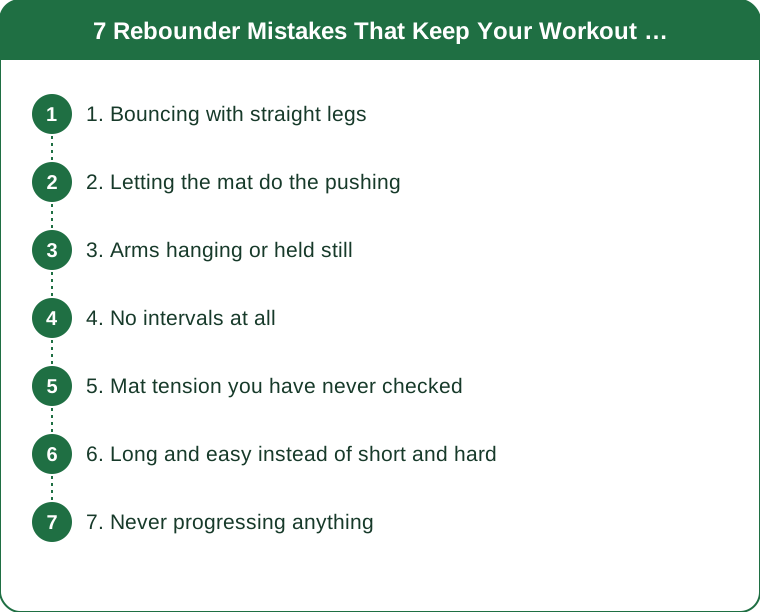
Quick Answer: Most rebounder workouts under-deliver for the same seven reasons: bouncing with straight legs, letting the mat do the work, no arm drive, no intervals, poor mat tension, workouts that are too long and too easy, and never progressing. Fixing the first three alone roughly doubles the effort of the same twenty minutes.
Rebounding feels easy in a way that makes people suspicious of it — and often that suspicion is justified. Not because the tool is weak, but because the tool makes it very easy to accidentally do nothing.
A rebounder returns energy to you. That is the whole point and also the whole trap: if you let it, it will do most of the work while you supply the rhythm.
Here are the seven things that decide whether twenty minutes counts.

1. Bouncing with straight legs
This is the single biggest one. Straight-leg bouncing lets the mat compress and rebound you with almost no muscular contribution — you are essentially a passenger.
Keep a soft bend in the knees throughout and absorb the landing. Your quads and glutes should be working on every single contact, the same way they would in a controlled squat. If your legs are not fatiguing at all, this is why.
Test it: bounce for 30 seconds straight-legged, then 30 seconds with soft knees actively absorbing. The difference in effort is immediate and large.
2. Letting the mat do the pushing
Related but distinct. There is a difference between being launched by the mat and driving into the mat.
Push down through the whole foot on every bounce. Actively drive your feet into the mat rather than waiting to be returned. The height you reach should come from your push, not from the rebound.
This changes the exercise from passive oscillation into repeated concentric work. Same visual, entirely different metabolic cost — most people find their heart rate climbs 15 to 25 beats per minute from this change alone.
3. Arms hanging or held still
Arms are a large mass and they are free intensity. Held still, they contribute nothing.
Drive them. Big alternating arm swings, overhead reaches, or punches on every bounce. Adding the upper body raises oxygen demand substantially and is the easiest way to make a rebounder session genuinely aerobic.
Light hand weights of 1 to 3 lb multiply this further, but do not add them until the movement pattern is solid — flailing weights on an unstable surface is how people hurt shoulders.

4. No intervals at all
Steady-state bouncing for twenty minutes at a comfortable rhythm is the default and it is where progress goes to die.
Structure it: 40 seconds hard, 20 seconds easy, repeated 10 to 15 times. Hard means high knees, tuck jumps, twists, or sprint bounces — something you could not sustain for five minutes. Easy means a gentle health bounce, not stopping.
A 15-minute interval session outperforms 35 minutes of steady bouncing on nearly every measure, and it is considerably less boring.
5. Mat tension you have never checked
A loose, sagging mat gives a deep, slow bounce that is hard to control and easy to be passive on. An overly tight mat is jarring and reduces the joint-friendly quality that made you buy it.
Check it: stand in the center and you should sink somewhere around 3 to 4 inches. Much more than that and the bungees or springs have stretched and want replacing — usually every 12 to 24 months with regular use.
Worn tension is also the reason a rebounder that used to feel great starts feeling either mushy or harsh.
6. Long and easy instead of short and hard
Rebounding is comfortable, so sessions drift longer and easier. Forty-five gentle minutes feels productive and delivers less than fifteen structured ones.
Cap it at 20 to 25 minutes and make those minutes count. If you finish and could immediately do it again, the intensity was the problem, not the duration.
The one exception is genuine recovery bouncing — a light 10 minutes for circulation and mood on a rest day. That is a different goal and should not be counted as training.
7. Never progressing anything
The same routine at the same intensity for six months produces exactly what you would expect.
Progress in this order: add arm drive, add single-leg work, add tuck jumps and twists, then add light hand weights. Each step is a real jump in demand and you can spend two or three weeks on each.
Single-leg bouncing is the most underrated progression — it roughly doubles the load on the working leg and adds a substantial balance demand. Ten seconds per side inside an interval is plenty to start.
This is general information, not medical advice. If you have joint, back, or pelvic floor concerns, get individual guidance before starting a rebounding program.
TL;DR:
- Keep soft knees and actively absorb every landing — straight-leg bouncing makes you a passenger.
- Drive down into the mat instead of waiting to be returned.
- Use big arm movements on every bounce; it is the cheapest intensity available.
- Structure the session as 40 seconds hard, 20 seconds easy, 10 to 15 rounds.
- Check mat tension — 3 to 4 inches of sink standing in the center; replace bungees every 12 to 24 months.
- Cap sessions at 20 to 25 minutes and make them hard rather than long.
- Progress deliberately: arm drive, then single-leg, then tuck jumps and twists, then light weights.
The rebounder is not a soft option — it is a tool that will happily let you take one. Change the first three things on this list and the same twenty minutes becomes a workout you have to recover from.
Keep Reading
This article is for general informational and styling purposes only. Fit, sizing, and product availability may vary.