7 Reasons Your Rebounder Workout Only Leaves Your Calves Sore
Quick Answer: Calf-only soreness means you are bouncing from the ankle rather than from the hip and knee. The mat returns most of the energy, so if you never let your hips and knees absorb any of it, the calves end up doing all the work by default. Bend deeper, land softer, and slow the bounce down — and the soreness redistributes to where it should be within about two sessions.
It is the single most common rebounder technique fault.
And all seven causes below feed into the same one mechanism.
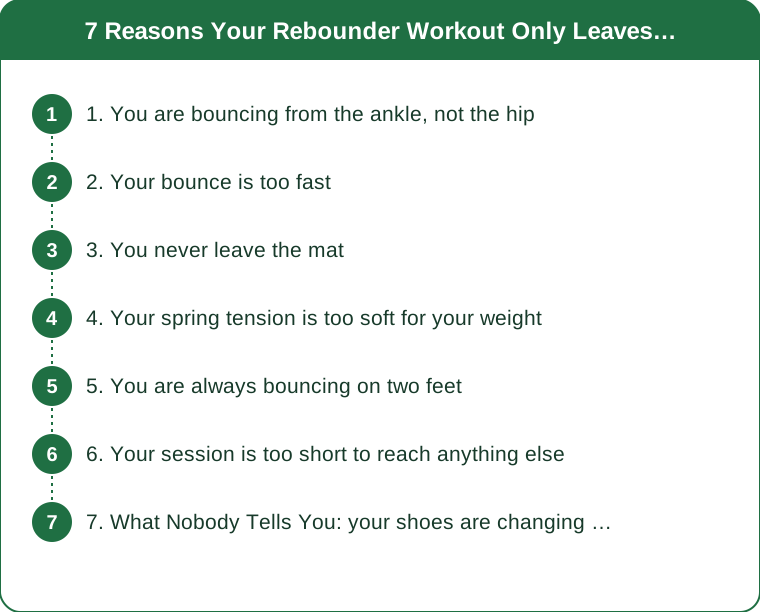
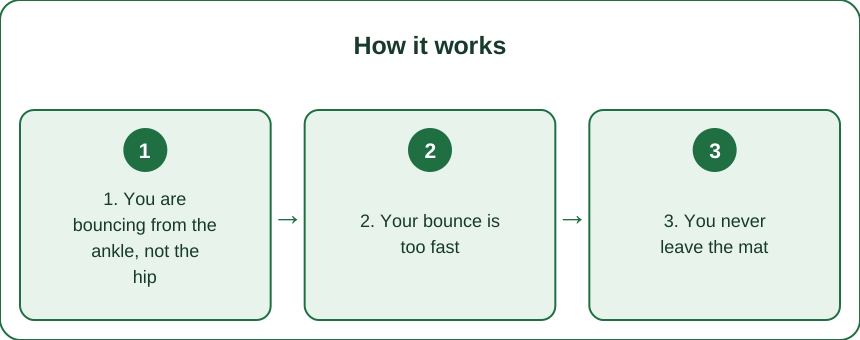
1. You are bouncing from the ankle, not the hip
This is the root cause and the other six are variations of it.
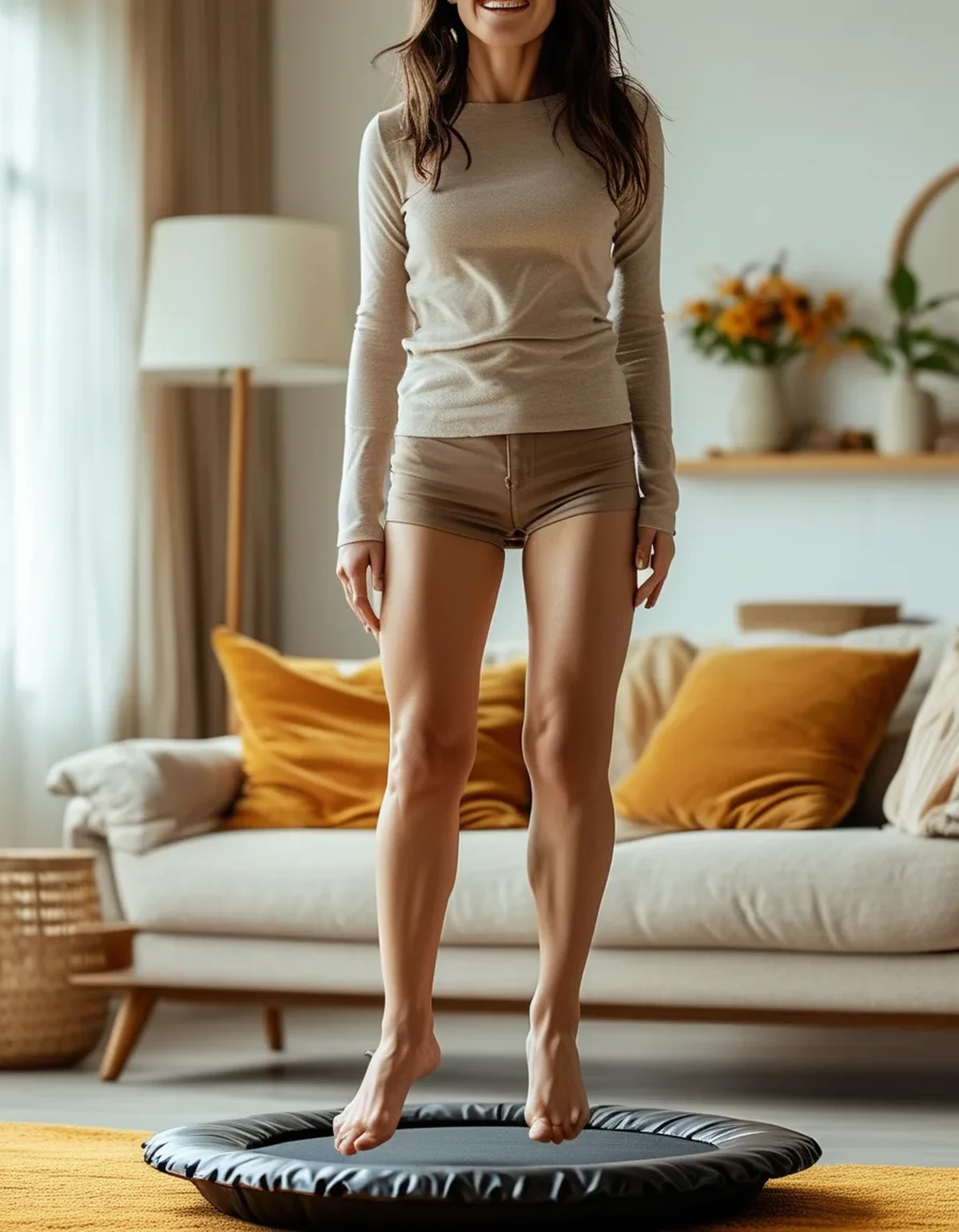
A rebound has two possible engines. The ankle engine is a small, fast, springy bounce driven almost entirely by the calf and Achilles — efficient, easy, and the default for anyone who has ever skipped rope. The hip engine is a larger movement where the knees and hips flex on landing and extend on the push, bringing in quads, hamstrings and glutes.
On a mini trampoline the mat gives you so much of the energy back that the ankle engine alone is enough to keep you bouncing. You never have to use anything else, so most people do not.
The correction is simply to bend more. Aim for a visible knee bend on every landing — enough that you could feel your quads working if you paid attention. It will feel like harder work and slower bouncing, because it is.
2. Your bounce is too fast
Speed pushes you toward the ankles automatically.
A fast bounce has a short contact time on the mat, and short contact time means there is not enough time for the hip and knee to flex and extend. The only joint that can cycle that quickly is the ankle.
This is why people who describe their rebounder sessions as high intensity are often the ones with the most isolated calf soreness — the intensity came from frequency, not from range.
Try deliberately halving your bounce rate for two minutes. Bigger, slower, deeper. It feels less energetic and it recruits far more muscle. Most people find their heart rate is higher after two minutes of slow, deep bouncing than after two minutes of fast shallow bouncing, which is a useful thing to discover.
3. You never leave the mat
A health bounce where the feet stay in contact is a legitimate and useful mode, but it is a low-force one.
If every session is a gentle feet-on-the-mat bounce, the force involved never gets high enough to challenge the larger muscles. The calves handle it comfortably, the quads and glutes are never recruited meaningfully, and you get exactly the soreness pattern you are describing.
Mixing in jogging, high knees, and jump-squat-style movements for even a third of the session changes the force profile completely. You do not need to make the whole session high-impact — the point is that at least some of it should ask the hips for something.
4. Your spring tension is too soft for your weight
A very soft mat exaggerates the problem.
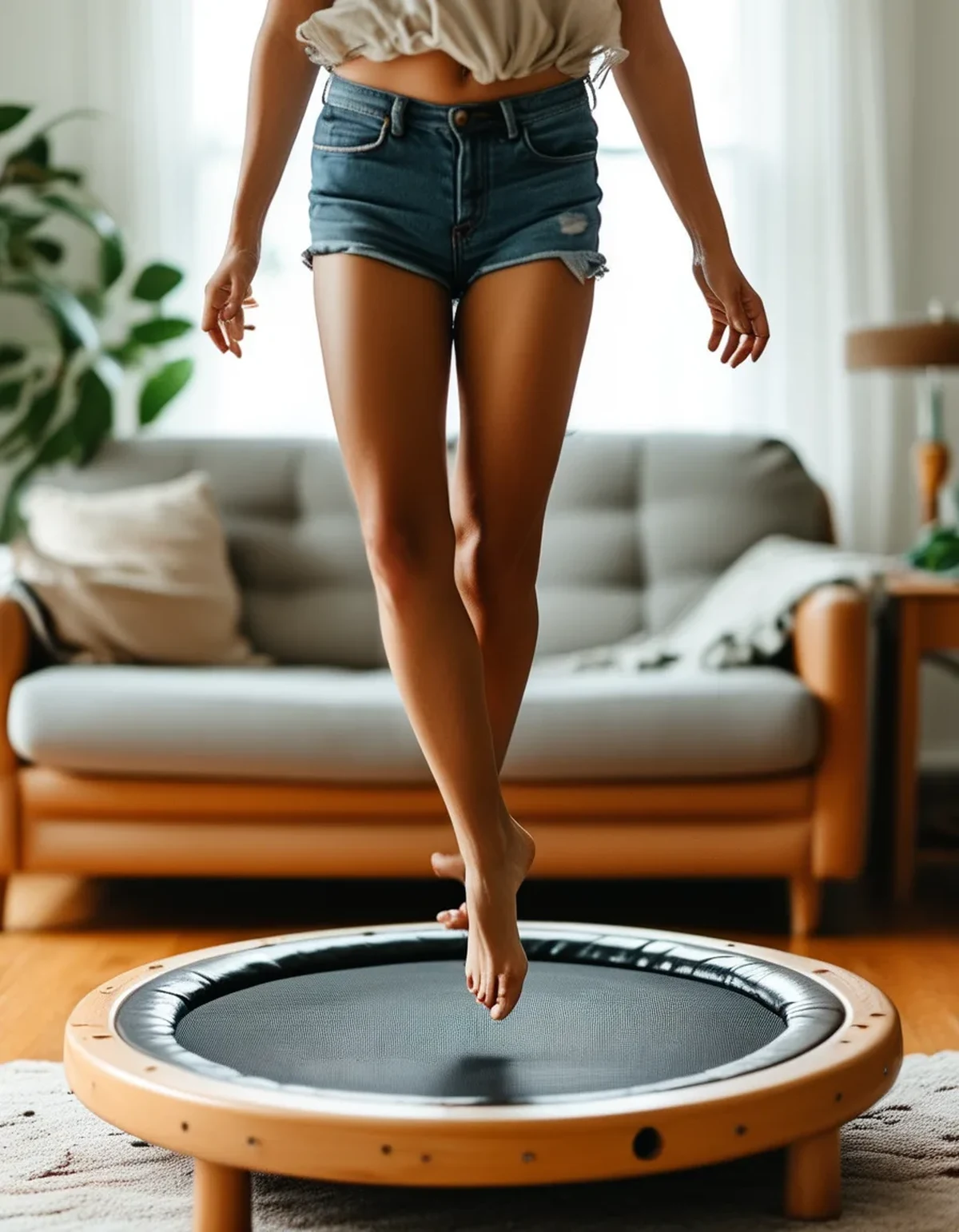
With bungee cords or soft springs, the mat sinks a long way and returns energy slowly. That gives you a lovely soft feel, and it also means the surface is doing more of the work and your legs less. The deep sink also encourages a small, quick ankle bounce because a big movement feels unstable.
Firmer tension returns energy faster and requires more from you to control the landing. If your rebounder has adjustable tension and you have never touched it, that is worth ten minutes.
If it is not adjustable, compensate with technique: land deliberately deeper, and add movements where the force is not purely vertical — side-to-side, twists, and single-leg work all recruit more than a straight bounce.
5. You are always bouncing on two feet
Bilateral work lets the calves cover for everything else.
On two feet, the load is split and the movement is symmetric — which is comfortable and undemanding. Almost any hip weakness or asymmetry is hidden.
Single-leg work exposes it immediately. Even a gentle single-leg bounce, ten or fifteen seconds a side, will make you feel your glutes and outer hip in a way two-footed bouncing never does. It also does considerably more for balance and ankle stability, which is a large part of why people bought a rebounder in the first place.
Start with a hand on a stability bar or a wall. Fifteen seconds per side, a few rounds, is plenty to change the soreness pattern.
6. Your session is too short to reach anything else
Calves have high endurance and fatigue late. Larger muscles need either more time or more force before they register.
A ten-minute gentle session is genuinely good for circulation and movement and will not produce meaningful soreness anywhere except, occasionally, the calves — which are working continuously the whole time.
If you want a rebounder session to feel like a workout in your legs generally, you need either 20 minutes or more with varied movements, or a shorter session with substantially higher force. Both work; the ten-minute gentle bounce does neither.
This is not a criticism of short sessions. It is just an explanation of why they produce the specific soreness pattern they do.
7. What Nobody Tells You: your shoes are changing the engine
Footwear on a rebounder matters more than on the floor, and in the opposite direction to what you would expect.
A cushioned running shoe on an already-soft mat gives you two layers of compliance. The combination is unstable enough that most people instinctively shrink their movement — smaller, quicker, more ankle-driven — to stay in control. So the cushioning that felt safer actually pushed you further into the pattern causing the soreness.
Barefoot or in grip socks, you feel the mat directly, the platform is effectively firmer, and bigger movements feel controllable. Most people naturally bounce deeper.
The caveat is that barefoot asks more of the foot and calf initially, so build up over a couple of weeks rather than switching for a 30-minute session.
This is general information, not medical advice. Persistent calf pain, or pain in the Achilles rather than the muscle belly, should be assessed rather than trained through.
TL;DR:
- Calf-only soreness means you are bouncing from the ankle instead of the hip and knee
- Slow the bounce down and bend the knees visibly on every landing
- Add single-leg work — it exposes the hip in seconds
- Check spring tension; very soft mats encourage small ankle-driven bounces
- Try barefoot or grip socks rather than cushioned trainers
All seven of these point at the same fix. Bounce bigger and slower for two sessions and see where you feel it afterwards — if the answer changes from calves to quads and glutes, you have found the whole problem.
Keep Reading
This article is for general informational and styling purposes only. Fit, sizing, and product availability may vary.