7 Reasons Your Rebounder Sessions Stopped Getting Easier
Quick Answer: Rebounding plateaus fast because the movement has a narrow intensity range built into it. The mat returns most of your energy, your bounce height self-limits, and the same twenty-minute routine at the same cadence provides an identical stimulus every session. Progression requires deliberately changing one variable at a time: bounce height, single-leg loading, arm position, cadence, duration, mat tension, or the addition of external load. Doing more of the same is the one thing that will not work.
Rebounding is genuinely effective and genuinely easy to plateau on, and the two facts are connected.
This blog has covered why mini trampoline workouts feel deceptively easy and why your rebounder squeaks. This is the progression problem, which is the one that decides whether it stays useful after month two.

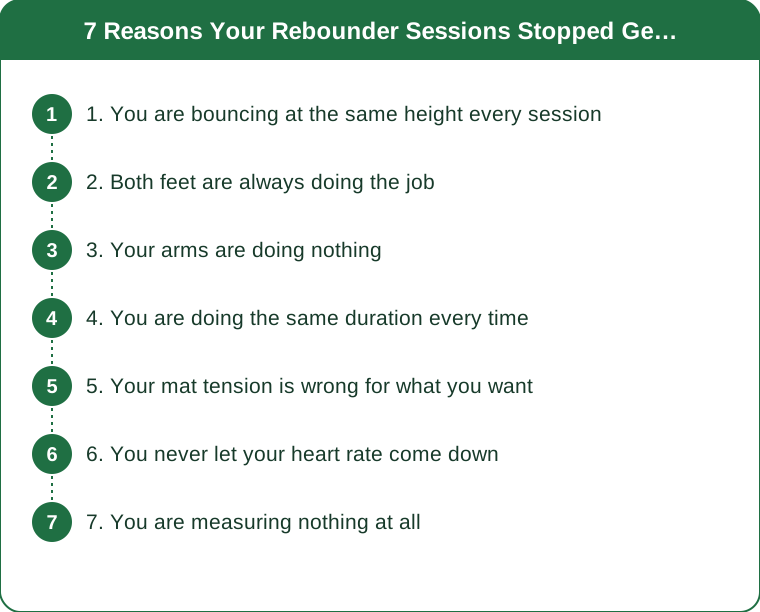
1. You are bouncing at the same height every session
Bounce height is your primary intensity dial and most people never touch it. A health bounce where your feet stay in contact with the mat is a completely different demand from a bounce where you leave the surface, and both are different again from a high bounce with a controlled landing.
The reason it stays fixed is that bounce height is self-selecting. You settle into whatever feels natural within the first minute and stay there for the whole session, and then for the whole month.
The fix is to structure it deliberately. Two minutes of low health bounce, one minute of moderate, 30 seconds of maximum controlled height, then repeat. Writing the heights into the session is the only reliable way to stop defaulting.
Higher bounces demand far more from your legs on landing, because you are absorbing more downward force. That absorption is where most of the training effect lives, and it is entirely absent from a comfortable steady bounce.
2. Both feet are always doing the job
Single-leg work roughly doubles the load on the working leg and adds a stability demand the two-legged version does not have. On an unstable surface, that stability component is substantial.
Most rebounder routines are almost entirely bilateral, which means each leg never handles more than half your body weight regardless of how long you go.
Add single-leg intervals of 20 to 30 seconds per side. Start with the foot staying in contact with the mat and progress to small hops as balance improves. This is the single largest jump in difficulty available without changing anything else.
It also addresses a genuine imbalance. Most people have a noticeably stronger side, and bilateral work lets the stronger leg quietly compensate for the whole session without either of you noticing.
3. Your arms are doing nothing
Arm position changes both the cardiovascular demand and the core requirement. Arms held overhead raise heart rate meaningfully at the same leg effort, because your heart is working against gravity to supply raised limbs.
Most people bounce with arms relaxed at their sides, which is comfortable and contributes nothing.
Try three positions in rotation: arms overhead, arms extended straight out to the sides, and arms performing a deliberate movement such as a press or a reach. Each changes the demand differently, and overhead is the most taxing.
Adding light hand weights of half a kilogram to a kilogram amplifies this considerably. Keep them genuinely light. The instability of a rebounder plus heavy weights is a poor combination, and the goal here is sustained demand rather than load.

4. You are doing the same duration every time
Twenty minutes, three times a week, forever, is a maintenance program. It maintains what you built in the first month and builds nothing further, which is exactly what you are experiencing.
Duration is the easiest variable to progress and the one people are most reluctant to touch, usually because sessions are scheduled around a fixed slot in the day.
Progress it in small increments. Adding two minutes a week reaches 30 minutes within five weeks without any session feeling different from the last.
Or increase density instead if time is genuinely fixed. The same twenty minutes with shorter recovery intervals between hard efforts is a real progression, and it fits the same slot in your day. Density is the underrated option for anyone whose constraint is the clock rather than motivation.
5. Your mat tension is wrong for what you want
A softer mat with more give returns more energy and makes bouncing easier. A firmer mat with higher tension demands more work from you for the same bounce height.
Most people never think about mat tension after assembly, and springs and bungees do lose tension over months of use, which means the same session is quietly getting easier over time.
Check the tension periodically. If the mat sits noticeably lower under your weight than it did when new, the springs or bungees have stretched and the workout has become easier without you deciding that.
Bungee rebounders are generally softer and quieter, and spring rebounders are firmer and more demanding. Neither is better, and it is worth knowing which one you have and what that means for the effort you are getting.
6. You never let your heart rate come down
Continuous steady bouncing at a moderate rate keeps you in a middle zone that is comfortable to sustain and produces limited adaptation. It is the cardiovascular equivalent of jogging the same pace for a year.
The rebounder’s forgiving nature makes this the natural default, because there is no terrain or wind to force variation the way outdoor exercise does.
Structure genuine intervals. Forty seconds of maximal effort, whether that is high bouncing, twisting, or single-leg work, followed by 80 seconds of low health bounce. Repeat eight to ten times.
The recovery portion is not optional and it is not wasted time. Coming down and going back up is the stimulus. Without a genuine low period, the high period is never actually high, and you spend the whole session in the middle.
7. You are measuring nothing at all
Rebounding is unusually hard to track, which is why plateaus go unnoticed for months. There is no weight on a bar and no distance covered, so there is no obvious number to watch.
Without measurement, progression is guesswork, and guesswork reliably defaults to whatever is comfortable.
Track two things, both simple. First, session structure: intervals, durations, and which variations you used. Second, an outcome measure such as heart rate during a fixed effort, or how many single-leg bounces you can do per side before form breaks down.
A useful monthly test: two minutes of maximum-effort bouncing, then record your heart rate immediately and again one minute later. The recovery figure improves with genuine cardiovascular fitness, and it is the clearest signal available that your training is doing something.
One caution worth stating: if you have any pelvic floor concerns, a history of joint problems, or you are postnatal, rebounding intensity is worth discussing with a professional before you progress it aggressively. This is general information, not medical advice.
TL;DR:
- Rebounding plateaus quickly because bounce height, cadence, and duration all self-select into a comfortable middle.
- The seven levers are bounce height, single-leg loading, arm position, duration, density, mat tension, and interval structure.
- Change one variable at a time and write it down, because there is no obvious number to track otherwise.
- Use a monthly two-minute effort plus one-minute heart rate recovery test as your progress measure.
Single-leg intervals are the biggest single jump available and cost nothing. Start there if you only change one thing.
Keep Reading
This article is for general informational and styling purposes only. Fit, sizing, and product availability may vary.